The experience of trekking in Manaslu in April is magical, as the harsh winter cold gives way to stable spring skies and trails gradually coming back to life.
Trekkers considering the Manaslu trek in April are usually weighing a few key questions: Is the weather reliable? Will the mountain views be clear? Is it feasible to cross the Larkya La Pass?
April delivers strongly in all three. For trekkers seeking reliable conditions and strong scenery, April is one of the most rewarding months for their trek to the Manaslu Circuit.
The weather is comfortably warm, vibrant rhododendrons bloom in the forests, and visibility across the Manaslu Himal is at its peak. While snow lingers at higher elevations, seasonal melting makes the ascent to Larkya La Pass (5,160 m) manageable as compared to the winter months. Also, unlike the pre-monsoon season, trails in April remain stable and predictable.
The result is a trekking experience that balances accessibility with remoteness. Teahouses reopen after winter, high passes become more predictable, and the landscape shifts rapidly from lush river valleys to alpine terrain under clear spring skies.

Highlights
- Forests and trails burst with spring colors as rhododendrons bloom across the lower and mid-hills
- Opportunity to see clear and beautiful views of Manaslu and the surrounding peaks under stable spring skies
- Daytime temperatures are comfortable for trekking on the Manaslu trek in April, and nights are cool but manageable
- Larkya La Pass is safer to cross following the melting of snow in April
- Chance to trek in solitude due to quiet trails, as there are fewer crowds here than on the Annapurna or Everest routes
- Bright skies and colorful scenery create ideal conditions for photography
Why Choose Manaslu Trek in April?
Among all trekking months in Nepal, April stands out for offering a balance between weather, scenery, and accessibility. Here are some reasons you need to be in the Manaslu region in April.

- Stable Weather: Manaslu April weather is known for consistent sunshine, minimal rainfall and clear mountain views. Daytime temperatures are comfortable in lower villages as well as in higher settlements.
- Blooming Rhododendrons: Spring transforms the Manaslu region into a living canvas of color. Forest trails are covered in beautiful hues of rhododendron blooms. Add to that the presence of magnolia and other wildflowers along with pine.
- Perfect Visibility: The dry air and calm skies mean you will enjoy unobstructed views of Manaslu, Himalchuli and Ngadi Chuli from several points along the route.
- Open Lodges and Trails: By April, all teahouses along the Manaslu Circuit are open after winter closures. This means the accommodation is comfortable and the food service is consistent.
- Moderate Crowds: The Manaslu Circuit maintains its remote charm even in peak months. You’ll meet other trekkers but still find long stretches of quiet trail.
Some Challenges
There are minor drawbacks to opting for the April Manaslu trek. They are:
- Snowmelt can make trails near Larkya La a bit slippery.
- Afternoon winds are common in this month, and they are strong enough to slow down your pace.
What’s the Weather Like in Manaslu in April?

Understanding Manaslu Circuit weather and climate in April is key to planning a safe and rewarding spring trek. April offers some of the most stable weather conditions for trekking the Manaslu Circuit. In the lower regions, such as Machha Khola (900 m), daytime temperatures average at 25°C. It means they are pleasantly warm. Meanwhile, evenings remain cooler at about 15°C. And this climate is perfect for acclimatization at the start of the trek.
As you ascend to places like Namrung (2,630 m) and Samagaun (3,530 m), daytime temperatures gradually drop between 12°C and 18°C, and nighttime lows reach near freezing at Samagaun. The trek’s highest point, Larkya La Pass (5,160 m), can be frigid, with daytime temperatures hovering around –2°C and nights dropping to –8°C.
Since April sits in the transitional period between winter and the monsoon, rainfall is minimal at this time of year, making Nepal’s spring trekking climate especially suitable for high-altitude routes like Manaslu. But you should expect short and light showers in the lower valleys. Yet snow is largely restricted to high-altitude sections near Larkya La. Interestingly, the snow begins melting along the pass by this time. As a result, the trail is safer and more accessible than in the preceding winter months.
Overall, April delivers a dependable trekking window featuring clear skies, moderate and predictable temperatures, and improved safety at high passes. These conditions make April one of the most reliable months for the Manaslu trek.
Are the April Trail Conditions and Scenery Worth the Visit?
Absolutely. April is basically one of the best times to trek this route. The lower trails are dry and easy to navigate, while the high altitudes retain their dramatic, snow-capped alpine look.
Here is what the Manaslu trek during April offers in terms of its conditions and scenery. These Manaslu trail conditions make Manaslu spring trekking both safer and more visually rewarding compared to winter months.
- The Colors: You are walking through the Budhi Gandaki valley right when the rhododendrons are popping off in shades of red and pink.
- The Views: April typically boasts clear skies, unlike May’s sometimes hazy skies. You’ll get consistent, high-definition views of Manaslu, Naike Peak, and Himlung Himal almost every morning.
- The Safety Factor: The footing is way more stable than in the winter months because the ice has mostly receded, but you avoid the pre-monsoon heat and humidity that starts to build up later in the spring.
If you want the classic Himalayan experience — clear peaks, blooming forests, and predictable trails —April is a total win.
Trekking the Manaslu Circuit in April

- Machha Khola to Namrung
Finding your rhythm is important during this section. In April, the trails here are mostly dry and solid underfoot. You’ll hit some narrow sections where the trail hugs the river gorge, but it’s nothing to stress about. The best part? The nasty icy patches that frustrate hikers in early March have usually vanished. As such, the hike is a pretty straightforward stretch with no challenging surprises en route.

- Namrung to Samagaun
As you start gaining real altitude, you will feel the temperature drop. The trail stays clear and well-defined, but you will start seeing snow hiding in the shadows or tucked into the trees, especially if you are on the trail early in the morning. Since April is well into the thaw, you are dealing with soft patches rather than the slick, frozen sections that you would find in January or February.

- Samagun to the High Pass
This section is where things get serious. Once you depart from Samdo, the wind intensifies and the ground remains pristine. However, April is known for the snowpack — instead of the deep, fresh snow, it’s usually compacted and firm. This is actually a win for you. It means the path offers better traction and a much safer, more predictable climb up to the Larkya La Pass than in the winter months.
- The Descent
The final push downhill in April is straightforward, with melting snow easing steep sections. In this section, trails plunge through rhododendron and pine forests, now fully thawed. Thus, muddy patches may appear from runoff. However, bridges hold firm over rushing streams. As you drive out from Dharapani or Tilche, you see roads are clear of winter debris, and thus the return is smooth.
Is Getting Permits Troublesome for the Manaslu Trek in April?

It’s not necessarily more difficult, but you definitely need to factor in some extra time. Because April is one of the busiest months for the Manaslu region, the permit offices in Kathmandu are usually buried in paperwork. Processing may take longer than during the quieter winter months.
All trekkers must secure the Manaslu Restricted Area Permit (RAP), along with the Manaslu Conservation Area Permit (MCAP) and the Annapurna Conservation Area Permit (ACAP).
Once you are actually on the trail, you will also notice that the checkpoints are much more thorough. Since there’s a higher volume of trekkers passing through, officials are a lot stricter about verifying documents and ensuring everyone is accounted for. As long as you get your application in early and have a licensed guide handling the legwork, you will be fine.
What’s Accommodation Like in Manaslu in April?

The availability of accommodation improves in April as this month kicks off peak trekking season post-winter. As a result, teahouses from Machha Khola to Bhimtang are fully open and bustling. There is no shortage of accommodation, like during off-months.
But there is higher occupancy in villages like Samagaun and Samdo in mid-to-late April. This means popular stops may fill earlier in the day. To avoid this, you should opt for advanced planning. Eventually, you will not face room shortages during peak weeks.
For trekkers planning their stay logistics, a shorter budget-friendly option follows the same teahouse accommodation standard along the Manaslu trail. The main and only difference is that Kathmandu accommodation is not included in this alternative.
Is It Hard to Find Good Food and Water When Teahouses Get Busy in April?
Food availability on the Manaslu Circuit in April is generally excellent, even during busy periods. As the trekkers’ traffic is higher, teahouses operate at full capacity. It means fresh ingredients are restocked more frequently than in winter. This results in reliable meals throughout the Manaslu trek route.
However, the main adjustment during peak April weeks is timing. Kitchens can become busy in the evenings, particularly in popular villages. Therefore, ordering meals earlier is one of the ways to avoid longer waits. Even so, despite rising demand, the food quality stays the same.
The access to water also improves in April as the spring thaw keeps local taps and supply lines running steadily. This is true, especially at lower and mid elevations. Boiled or filtered water is widely available at teahouses. As such, you need not entirely depend on bottled water along the trail.
How Difficult Is the Manaslu Trek If I Go in April?

The Manaslu Circuit is officially labeled as a strenuous trek, but the stable weather in April actually helps reduce many of the seasonal challenges you would face at other times of the year.
Trail stability is a key advantage during this period, especially when trekking Manaslu in April compared to late spring or monsoon months — most sections are dry and firm. Add to that the lingering winter snow that is largely confined to higher elevations. Even the crossing of Larkya La Pass becomes more predictable in April because the snowpack is compacted.
Milder daytime temperatures also help reduce cold-related fatigue, particularly at mid-elevations. Eventually, these conditions make trekking days more manageable. They also allow trekkers to move with greater confidence on the trail.
However, altitude remains the primary challenge in April as well. Crossing the high pass of Larkya La still requires careful acclimatization as well as early starts. Strong winds and freezing morning temperatures are common at higher elevations.
Do I Need Any Special Packing Adjustments for the April Manaslu Trek?
You don’t need heavy winter gear for a Manaslu hike in April, but a few small adjustments make a big difference. The lower valleys are pleasantly warm, almost like a typical spring day, but as you climb higher toward Larkya La Pass, the air turns crisp and cold, especially in the early morning and evenings.

So, to address this variation, a three-layer approach works best for April when packing for the Manaslu trek.
- Carry Layers: Lightweight layers (of clothing) keep you comfortable during sunny daytime walks. Meanwhile a warm jacket or fleece is handy for mornings, evenings, and higher camps.
- The spring sun is also surprisingly strong at altitude. To walk comfortably and to avoid sunburn on clear days, bring sunscreen and sunglasses.
- By this time of year, winter snow has mostly melted or compacted, so you can leave the heavy technical snow gear behind.
- Packing is simpler than in the dead of winter, letting you move lighter and focus on the views rather than hauling extra weight.

How Do I Stay Healthy and Manage Altitude in Manaslu During an April Trek?
April makes staying healthy a bit easier because the weather is more predictable and the trails are drier. However, the high altitude at Larkya La still demands careful acclimatization. Even with the spring sun out, the Larkya La Pass is a serious climb, so the best strategy is simply to take your time. Sticking to your acclimatization days and keeping a slow, steady pace is the most effective way to help your body adjust to the thinning air.
Staying in top shape on the trail mostly centers around these essentials:
- Hydration: You should be aiming for 3 to 4 liters of water a day. If you are drinking from the local streams, just be sure to use purification tablets or a filter. Do not trust the purity of April’s meltwater alone.
- Mountain Diet: Stick to hot, freshly cooked meals like dal bhat. It’s generally a good idea to skip raw salads once you are above 2,000 meters and definitely hold off on the alcohol until you have finished the high pass. That is because it will make acclimatizing harder.
- Know the Signs: Pay attention to your body. If a headache or nausea starts to kick in, don’t ignore it. The best ‘medicine’ for altitude is almost always a slow descent to a lower elevation, where the air is thicker.
- The Safety Net: One major perk of April being peak season is that since the trail is busy, support and communication are much easier to find if you do run into a health issue.
As long as you have a basic first-aid kit and listen to your guide’s advice, you can focus on the scenery rather than worrying about your health.

Since I’m Trekking in April, Are There Any Specific Local Celebrations I Should Look For?
Yes, April is a fantastic time for culture because the mountains are waking up from their winter slumber. With the weather warming up, the villages are buzzing with activity, and you are likely to catch several local traditions and festivals along the way.
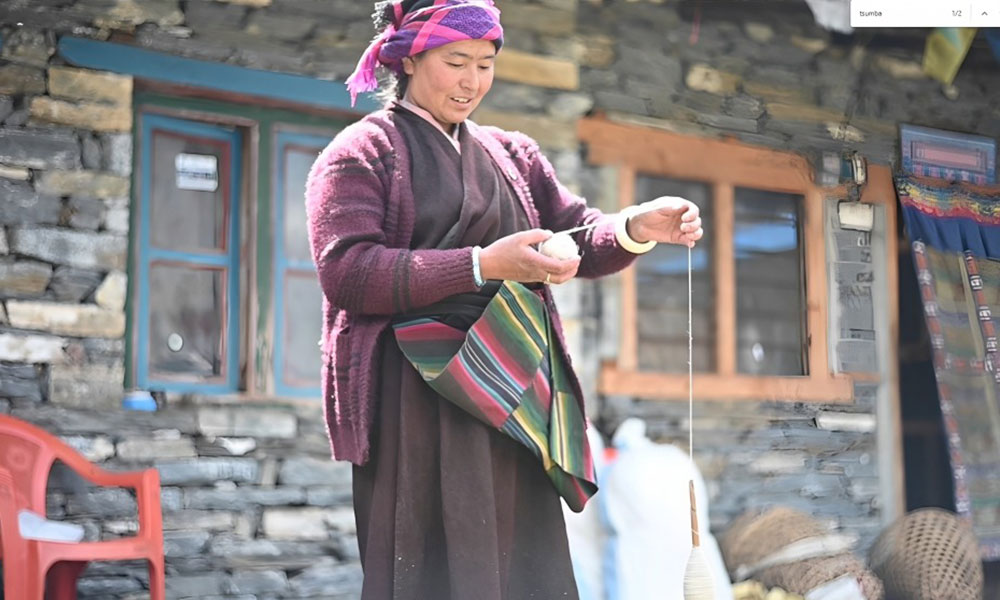
- Farming Life in the Lower Valleys: From Machha Khola up toward Namrung, Gurung communities return to the fields. It’s the start of the planting season, so the terraced hillsides are alive with people prepping the land for rice and millet.
- Spiritual Rhythms in Lho and Samagaon: In the mid-section of the trek, the Tibetan Buddhist influence becomes very visible. You’ll pass villages where locals are busy at the monasteries. Depending on the lunar calendar, you might catch Buddha Jayanti (celebrating Buddha’s birth, enlightenment, and death) toward late April, complete with monastery prayers and colorful processions.
- Chaite Dashain: This ‘mini-Dashain’ usually falls in the middle of April. In mixed-culture villages, Hindu families gather for blessings and small local feasts.
- Tibetan Heritage of Samdo: At Samdo, the culture is purely Tibetan. You’ll see herders moving yaks and locals performing daily kora (circumambulation) around ancient chortens. It’s a wonderful time to witness this high-altitude lifestyle in its most authentic form before the monsoon arrives.
If you are planning to trek during peak spring conditions, like in spring, trekking with experienced local guides can make a real difference in the kind of experience you have during the journey. Radiant Treks specializes in guide-led journeys that prioritize safety along with authentic experience on the trail.