

Introduction to the Manaslu Annapurna Circuit Trek
The Manaslu Annapurna Circuit Trek is a trek that offers the best blend of breathtaking landscapes, rich cultural heritage and challenging adventure. The trek blends remote, pristine beauty of the Manaslu Circuit with classic high altitude trails of Annapurna Circuit into the most amazing trekking in the Himalayas.
The trail takes off from the Manaslu Conservation Area, Tibetan influenced villages, dramatic gorges, glacial rivers and then enters the world renowned Annapurna region where dramatic peaks and deep valleys make up the scenery.

You will encounter two thrilling high altitude passes during the course, Larkya La Pass (5,106m) and Thorong La Pass (5,416m). You will cross both of them with incomparable views to admire all the way along. You will go through charming Gurung, Magar, Thakali, Manangi villages where the local people welcome you with warm hospitality and their centuries old traditions.
From its step to its end, every step of this trek immerses you into pure nature, pure spirit of Buddhism, and pure power of Himalayas, and thus, connects with the culture of Nepal’s beautiful mountain. Manaslu Annapurna Circuit Trek is not just a race to the highest pass, it is also a race to spend time with the soul and the benefit of some of the most spectacular landscapes on earth.

Highlights of Manaslu Annapurna Circuit Trek
- Take in the awe inspiring views from Larkya La (5,106m) and Thorong La (5,416m) and be surrounded by Himalayan summits.
- Be part of the vibrantly cultural Tibetan influenced villages such as Sama Gaun, Samdo, Manang and its lively traditions.
- Visit old monasteries of Pungyen Gompa and Braga Monastery to see the living Buddhist monks preserve sacred teachings.
- Marvel at the changing terrain traversing lush forest, alpine meadow, glacial valley and high altitude plateau.
- Look for rare Himalayan wildlife such as snow leopard, Himalayan tahrs and red pandas in protected conservation areas.
- Enjoy soaking in the natural, hot water hot springs at Tatopani as a gentle way to recover from days of trekking.
- Trek the legendary trade routes in Nepal once tracked by merchants heading to and from Tibet.
- Get to know the spiritual aspect of Muktinath Temple, which is considered as one of the revered pilgrimage sites of Hindu and Buddhist traditions.
Detailed Itinerary of Manaslu Annapurna Circuit Trek
We start the Manaslu Annapurna Circuit Trek adventure on an amazing drive from Kathmandu to Machha Khola including a ride of about 6 to 7 hours. It begins on a smooth highway that quickly turns into the rough mountain roads that eventually follow the Budhi Gandaki River.
On the way, we walk through Arughat Bazar, which was an old trade center in the past where goods were traded from Nepal to Tibet. The trek ahead is set by the changing landscapes from bustling towns to terraced fields and the misty hills. By the time we reach Machha Khola you’ll already notice the change to a quieter and more remote part of the country. We are at a cozy guest house here, absorbing the cool mountain air, ready to start the trek.
The second day entails trekking from Machha Khola to Jagat for a full day. Our trail is a series of suspension bridges, dense forests and a number of small villages. Tatopani is also one of the highlights, as it offers natural hot springs, and a chance to dip your feet into warm, and mineral rich waters thought by the locals to have healing properties.
We make our way through Dobhan and Yaru Bagar, and finally reach Jagat, a historic village that was once a tax collection post for traders. Here, you can see both the Hindu and Buddhist traditions blend together with a prayer flag or two flapping in the wind, and small shrines tucked on the trail. We rest for another rewarding day, staying tonight in a guest house.
On the third day we leave Jagat and the terrain behind us becomes high altitude and it takes a six to seven hours trek to Namrung. Salleri and Sirdibas are the villages through which the trail runs, and here we see the beginnings of Tibetan Buddhist culture.
A farming community called Philim is surrounded by lush golden fields of barley and maize and when we reach the area, we stop to appreciate the tranquil scenery of the region. On our way passing Ekle Bhatti towards the mystical Tsum valley, we gradually climb up towards Deng, which informs us we entered the deep soul lands through prayer wheels and mani walls. The villages become more dramatic, and as we reach the village of Namrung, they welcome us with tremendous views of the Ganesh Himal and Himalchuli. A simple but hearty meal is what you taste while spending the night in a small but endearing guest house, where you can take some time to think about the day’s adventure.
The fourth day begins our trek into the depths of the mountains, namely from Namrung to Sama gaun with the most incredible scenery of the hike so far. A striking first view of Mount Manaslu (8,163m) that towers into the sky is seen along the way, as one drives by the Lho Village.
Now we stop by the monastery and find ourselves in a peaceful alcove where monks carry out their daily rituals. As we continue trekking, it opens up to Shyala Village, where the views of the Himalayas, Ganesh Himal, Himalchuli and peak 29 are spectacular.
Towards the end of the day, we reached the biggest settlement in the upper Manaslu region, Sama Gaun. Buddhist traditions run deep here as they had historically been a trading point for Tibetans and Nepalese merchants.
From here you can take a chance to see Pungyen Gompa, a monastery in the hills with its spiritual and historical value to the region. Lots of people make the decision to spend a night or two in Samagaun to help acclimatise before the ascent. We rest tonight at a guest house with the noise of prayer chants and mountain winds.
On the fifth day we have a well deserved acclimatization day in Sama Gaun, allowing our bodies to adjust to the previously rising altitude before climbing higher into the mountains. Resting is important, but we do also have the opportunity to hike to either Manaslu Base Camp (4,800 m) or Pungyen Gompa which are also highly rewarding experiences.
The trek to the base camp is much more demanding, but does reward you with jaw dropping views over the Manaslu Glacier, that stretches for good as it traverses across the rugged terrain. For those who like their experience more cultural, Pungyen Gompa is a hidden secret, located in the hills, an ancient Buddhist monastery with a rich history and spiritual significance.
The gompa is met with deep protective energy over the valley and locals believe that. Whether we take this route or the second route, we spend the night in Sama Gaun, in a comfortable guest house and readying ourselves for the next trek.
On day six we leave Sama Gaun and we trek to Samdo which is a short distance but an important one that should take about four to five hours. As we ascend, the forest thins and alpine eroded by glaciers becomes dramatic with fewer trees, and large glacier carved valleys.
We see the yaks grazing by Kermo Kharka, which shepherds from Tibet have grazed for centuries. One of the last settlements in the area before the high mountain pass, Samdo itself sits at 3,875 meters. This village has an important history as an important stopping point on the salt route between Tibet and Nepal and even today, many locals have strong Tibetan roots. Once settled, we head out to explore the village with a short acclimatization hike, getting to know about the lifestyle of village life in such remote conditions and return back to our guest house for the night.
We continue our walk to Dharamshala (4,460m) or Larke Phedi on the seventh day, which is the basecamp for crossing Larke Pass. It is a five to six hours hike and the altitude makes it strenuous, but the scenery surrounding it provides motivation.
The trail along the Larke River travels through bare rocky terrains with scenery consisting of stunning mountain views in all directions. Remnants of ancient pilgrimage routes along the way have prayer flags scattered in intervals.
In fact, Dharamshala itself is a small, rather isolated, and offers only a couple of very basic lodges where trekkers rest before finally climbing over Larke Pass. At this point we are ready for the most difficult section of the trek so we’ll top off on some warm food ahead of an early night’s sleep.
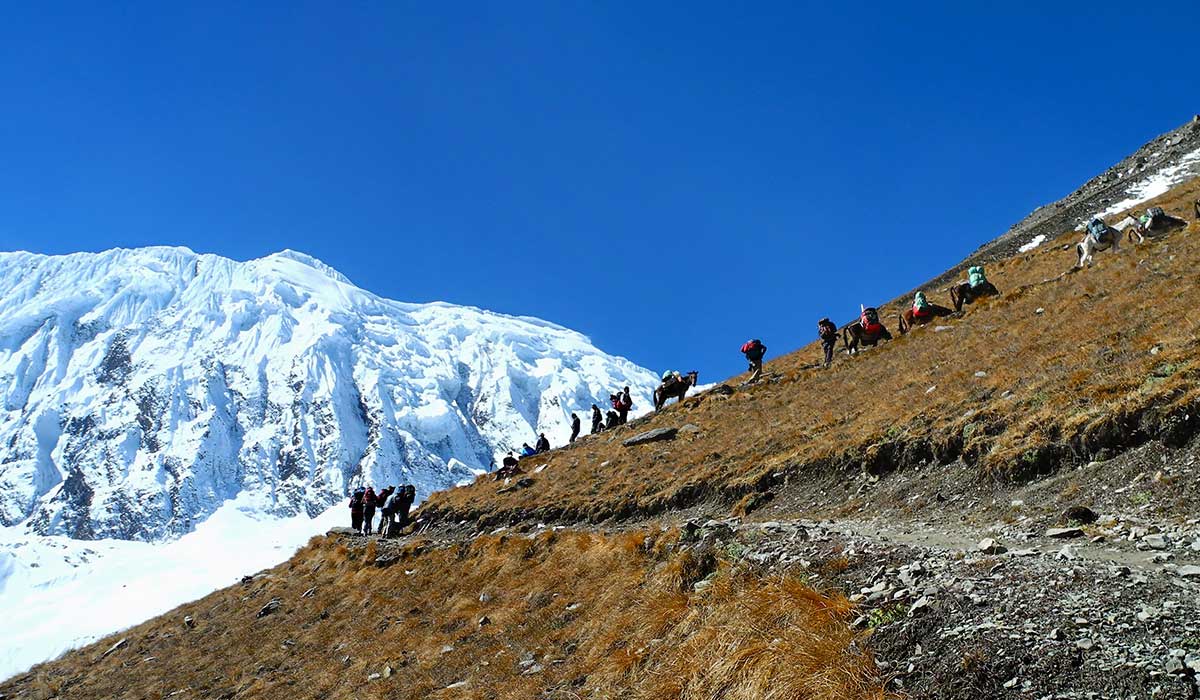
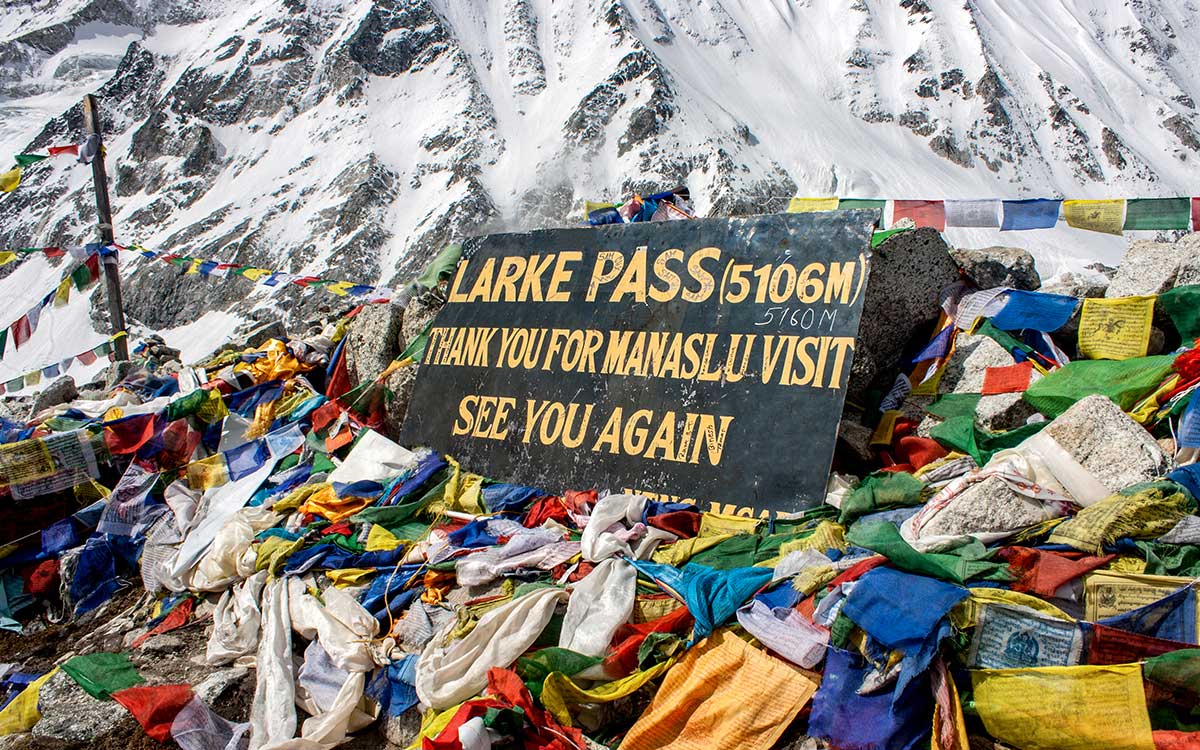
The most difficult but fulfilling day of the trek is on the eighth day when we get up early and walk the highest point of the trek, Larke Pass (5,106m), and descend to Bhimtang (3,720m). It is a fairly easy 7 to 8 hour trip, starting with a gradual climb across the moraines, with the pass then being reached.
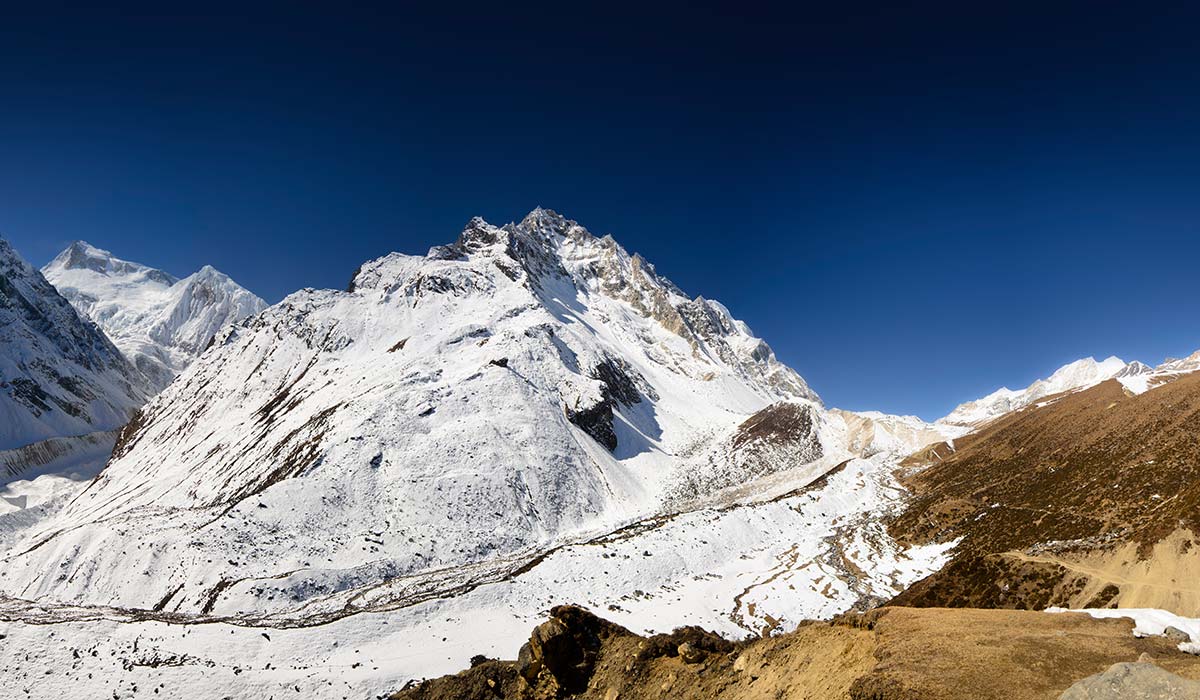
It is simply breathtaking from the top with a sweeping panorama of Himlung Himal, Annapurna II, Cheo Himal, and Kang Guru. Standing on one of the highest points of the trek, we can feel the sense of accomplishment and take in the scale of the expanse that is the Himalayas.
The descent to Bhimtang is steep with freezing ridges, steep walking through the valley and various glaciers, but as you come to lower altitudes, the land becomes greener. Bhimtang gives the impression of a beautiful place to rest, with forests and meadows on all sides and beautiful views of Mount Phungi Himal. At a guest house, we spent the night celebrating the awesome achievement of crossing Larke Pass.
On the ninth day, our trek to Tilche from Bhimtang goes through some of the most stunning scenery of the trek. Leaving Bhimtang, the trail continues to descend through pristine rhododendron forest with grand views of Phungi Himal and Himlung Himal.
We wind down from high-altitude wilderness through the crossing of glacial streams and alpine meadows, until they move into more settled villages. The way passes Surki Khola which is a perfect place for short rests and continues to Gowa, a small village with a plenty of Gurung culture.
At the end of the day, we are swept up in Tilche, located at the border between Manaslu and Annapurna, that being a key moment in our trek. We spend the night here at a guest house and avail of the locals’ hospitality.
On the tenth day, we take a private jeep from Tilche to Manang, which will take almost six to seven hours by jeep. The way passes through the Marsyangdi Valley which is rich in deep gorges, high cliffs and remnants of old settlements.
Although a rough road, it is a very beautiful one with wide views of Annapurna II and Gangapurna commanding the skies. Manang is one of the most culturally rich villages in the area and as you’re entering the village you see the traditional mud brick houses and the colorful prayer flags in the wind.
Once a stopping place for traders traveling between Nepal and Tibet, Manang is still a hub for travelers. After settling in, we explore the village, Gangapurna Lake and historic Braga Monastery are a part of the exploring, which has centuries old Buddhist manuscripts preserved. With a warm meal, we spend the night in a guest house which we use as a starting point for preparing for the trek ahead.
We trek to Yak Kharka from Manang on the eleventh day and which takes four to five hour. It starts to get noticeably higher, the scenery opens up into open pastures where yaks graze and snow-covered peaks are seen in the background. Towards the end of the trek, we pass by Gunsang, a tiny settlement that provides spectacular views of the Annapurna range. It follows the Thorong River through barren cliffs and thin vegetation. And it’s becoming crisp and cold closer to Yak Kharka, an essential acclimatization stop before Thorong La Pass. Having settled into a guest house, we rest well in order to adjust to the altitude and continue further.
On the twelfth day, we trek from Yak Kharka to Phedi, which is known as Thorong High camp, the highest point from where we trek through Thorong La Pass. It ascends gradually but demands much, going over rocky terrain and sparse landscapes left by the cruel alpine climate.
We pass Ledar, an isolated settlement commonly stopped for trekkers to gaze upon the entire ridge lines that extend into the distance. The last piece between Phedi and us is a couple of glacial streams to cross through, and the route is dotted more and more with prayer flags. From Phedi, we move to a guest house, conversing with teammates and getting psyched up for the thrilling experience of crossing Thorong La Pass the next day.
Day thirteen gets us into some of the most challenging and rewarding part of the trek, we cross Thorong La Pass (5,416 m), descend into Muktinath. This seven or eight-hour trip begins early in the morning to make it past the diabolical winds that set in later in the day. The climb is steep, strenuous, and takes one through rocky terrain while being marked by prayer flags.
Finally, after our struggle, as we reach the top of Thorong La we stop and the breathtaking wide view of Dhaulagiri, Annapurna, and Nilgiri can be seen on the horizon. Located high in the mountains, this pass has been an important road for traders and pilgrims for hundreds of years but links the districts of Manang and Mustang.
Muktinath (3,800m) is a long descent to a beautiful place that has a changing landscape of barren rock formations to greener valleys. We arrive in Muktinath and we stay in a guesthouse, taking in the soothing spiritual energy of this holy place.
Fourteenth day is for visiting Muktinath Temple, Nepal’s most revered shrine for Hindus as well as Buddhists. It is the temple that has the everlasting flame of centuries as well as 108 stone water spouts from where devotees bathe in icy waters as a part of their religious rites.
The site is considered as spiritually significant as it is believed to give moksha (liberation) to those who visit. We take a public bus from tailback temple grounds through Kali Gandaki gorge (world’s deepest gorge) to Pokhara, a stunning seven to eight hour drive.
The route visits Jomsom, Marpha and Tatopani where you can catch a glance of apple orchards, traditional Thakali villages, and dramatic river valleys. When we reach Pokhara, we check into a decent hotel and feel the difference of watching rugged mountains into the serene water-body of the lake.
Fifteenth day is a leisure day in Pokhara, where we visit some of the landmarks. We first visit Pumdikot, from where you can have a splendid aerial view of Pokhara, Phewa Lake, and the Annapurna Range. It boasts a new Lord Shiva statue, another new attraction for the city. We go next to Davis Falls, a mighty waterfall underneath that vanishes deep into caves of mystery below, with all a natural wonder like Pokhara has to offer. The last stop is to Bat’s Cave, an underground cavern that houses hundreds of bats, making for a fun close to the day. As Pokhara is relaxed, lakeside cafés provide a pleasant setting to relax after the trek.
On the last, the sixteenth day we fly back from Here to Kathmandu, enjoying the views of mountain ranges and river valleys from the air. Once you land there’s time to reflect on the amazing experience you’ve gone on during the two most iconic trekking circuits of Nepal. The Manaslu Annapurna Circuit Trek, with its cultural richness and the dramatic landscapes of Annapurna will be an experience of a lifetime.
Trek Cost Details
Cost Includes
- Private vehicle transfers for airport pick-up on arrival and drop-off on departure
- All ground transportation as outlined in the itinerary (local bus or private jeep)
- All necessary permits: Manaslu Restricted Area Permit, ACAP, and MCAP
- Licensed, English-speaking trekking guide
- Three meals per day (breakfast, lunch, and dinner), and seasonal fruits post dinner throughout the trek
- Accommodation in teahouses or lodges during the trek
- Hotel stays in Kathmandu and Pokhara (as per the itinerary)
- First-aid kit, oximeter, and necessary safety equipment
- Duffel bag, sleeping bag, and down jacket provided for trekkers (to be returned after the trek)
- Emergency rescue services (costs to be covered by the trekker or their travel insurance)
- Company-branded route map and T-shirt included
- Meals, accommodations, salary, and insurance for guides
- Government taxes and service charges
Cost Excludes
- Porter service. Extra cost $320 (shared between two trekkers)
- Personal trekking gear and equipment
- Travel insurance (best if it covers high-altitude trekking and emergency evacuation)
- Cost of meals and extra nights' stay in Kathmandu or Pokhara beyond the itinerary
- Bottled drinks, snacks, or any personal expenses during the trek
- Tips for guide and porter
- Optional domestic flight from Jomsom to Pokhara (if chosen)
- Any costs due to unforeseen circumstances (eg., weather, natural disaster, etc.)
Frequently Asked Questions
General
If you’d like to get the best weather, most clear views, and most ideal trekking conditions, spring and autumn are the best times to plan the Manaslu Annapurna Circuit Trek. The lower valleys are quite spectacular in spring (March to May) with colorful rhododendron blooms and mild temperatures, all the scenery captured perfectly throughout the lower forests and meadows.
Weather is consistent during this season, there are less chances of snow blockages on passes, and temperatures are moderate which makes trekking comfortable.
The second best season to visit is autumn (September to November), the sky is crystal clear, the air is crisp and the trekking is perfect. It clears the dust out of the air and gives you the unmatched Himalayan visibility, without the dust, you will be able to see Manaslu, Annapurna and Dhaulagiri without obstruction.
Along the way, the villages feeding the trail also seem livelier, with locals celebrating festivals like Dashain and Tihar, providing a great opportunity to experience Nepalese culture at its best.
Other times of year are more problematic; while heavy snowfall and extreme cold make passes such as Larkya La and Thorong La dangerous, they are impassable in winter (December to February). The monsoon (June to August) is the same; its mists lead to landslides while creating slippery trails and bad visibility. Manaslu Annapurna Circuit Trek also offers solitude and adventure, and fewer crowds can be found during winter with other tourists because hiking in the snow is more dangerous.
Due to the fact that there are very diverse geographies in Nepal, Manaslu and Annapurna trekking seasons differ depending on the area. Knowing that weather changes over the course of the year enables you to be properly equipped for Manaslu Annapurna Circuit Trek, as well as avoid extreme conditions and choosing the perfect trekking window.
Spring (March to May)
One of the best trekking seasons is spring which provides clear skies, moderate temperature and colorful scenarios. At lower elevations daytime temperatures are 10°C to 20°C (50°F to 68°F) and colder than -10°C (14°F) higher up.
There are rhododendron forests in bloom, rivers flows stably, the snow melts gradually, allowing crossings at Larkya La and Thorong La to become easier. Late in the season, occasional pre-monsoon showers may occur.
Monsoon (June to August)
The monsoon is one with heavy rainfall, landslides, and muddy trails below 3,500m. The swollen rivers, the leeches and fog-covered views turn trekking in Manaslu and lower Annapurna around into something that enters a new league.
The areas at higher altitude are drier, but they are dangerous, weatherwise, unstable and subject to rockslides and that makes trekking into the high altitudes truly an off season. But Mustang’s rain shadow region is quite dry and therefore makes for an alternative trek.
Autumn (September to November)
The best trekking season is considered autumn, when the air is crisp, the weather is stable and the views of the mountains are excellent. Valleys have temperatures of 12°C to 22°C (with 54°F to 72°F) while temperatures at a pass may fall to -5°C (23°F).
Dust and haze gets cleared for unmatched Himalayan visibility. High-altitude crossings are safe on trekking trails as they are dry and firm. Along the route are villages that receive a colorful atmosphere due to cultural festivals like Dashain and Tihar.
Winter (December to February)
The coldest season is winter when temperatures fall to around -15°C (5°F) in high altitude. Crossing Larkya La and Thorong La both are also possible although heavy snowfall blocks the passes, making crossings risky or impossible.
However, sub-zero nights are experienced in the lower villages. During winter, you need extra gear, layers, and flexibility, but in return you get solitude, views of frozen waterfalls, and quieter trails for experienced trekkers.
The right season is important to make sure that you are safe, you are comfortable as well as experience the best Himalayan.
Manaslu Annapurna Circuit Trek is moderate to hard in difficulty, unless you have strong physical endurance, strong mental preparedness and experience at high altitude. This is not a casual walk, this is a multi week immersion with two high altitude pass crossings, long trekking hours and large elevation gain.
The Manaslu section is harder to deal with as compared to others, as it is very remote, has steep ascents and lesser infrastructure. You will cross Larkya La Pass (5,106m) in your crossing of the range, enabling you to traverse deep gorges, suspension bridges and glacial moraines with altitude and cold winds tested.
In the Annapurna section of Nepal, which is more established, has its challenges with Thorong La Pass (5,416m) being one of the highest trek passes. One needs to get acclimated and have strong stamina to face this.
You should be prepared to do high altitude walking of 6 to 8 hours a day on trails with seriously diminished oxygen levels. It allows one to adapt to the gradual ascent, but certainly not out of altitude sickness. Training before doing Manaslu Annapurna Circuit Trek, making you more cardiovascular endurance, leg strength, and mental strength, it makes all the difference. It can be done by first time trekkers in good shape, but trekking experience is an advantage.
Recommended read: Manaslu VS Annapurna Trek
Preparation for a successful Manaslu Annapurna Circuit Trek begins weeks prior to you ever stepping in Nepal. You have to acclimatize by planning a steady ascent, so your body can adjust to less oxygen in the air. Having prior training, such as hiking to build endurance and strength building exercises will also help you in handling the long trekking hours.
You will need to pack smartly, layered clothing as temperatures are unexpectedly hot and cold, quality trekking boots, a warm sleeping bag (-15°C rating), and trekking poles for stability. Come prepared to expect the unexpected with a comfortable backpack, a hydration system, altitude sickness medication, etc.
As the trek requires permits for the Manaslu Restricted Area Permit and Annapurna Conservation Area Permit, best to sort it out as early as possible to avoid the last minute hassle. It also makes hiring an experienced guide and porter much easier, as the mountain terrain can be challenging, and his money supports the local economy. Diet and hydration play a large role, drink 3 to 4 liters of water daily, eat adequate carbs, protein and avoid alcohol (it dehydrates at high altitudes). Manaslu Annapurna Circuit Trek is all about physical, mental and logistical preparation and this will enable you to savor every moment without any unforeseen turns.
The highlight of Manaslu Annapurna Circuit Trek involves some exhilarating challenges, in crossing Larkya La (5,106m) and Thorong La (5,416m), to some of the highest trekking points in Nepal. Every pass has breathtaking views, but do not expect to run, they also test stamina, ability to cope with thin air and extreme cold, not to mention steep inclines.
The place Larkya La is situated belongs to Manaslu region and the place is famous for its glacial landscape, harsh winds, and one of the best views of Manaslu, Cheo Himal, and Himlung Himal. It is a tough climb, with some very steep ice covered ridges, but summiting is most rewarding. It is important you time it right as crossing early in the morning avoids strong winds and unstable weather conditions.
Even more well known is Thorong La on the Annapurna Circuit which is higher. It is one of the biggest trekking passes of Nepal linking the regions of Manang and Mustang with amazing views of Dhaulagiri, Annapurna and the Kali Gandaki Gorge. Every step of the climb is harder due to freezing temperatures and lower oxygen.
Both passes in the Manaslu Annapurna Circuit Trek require careful acclimatization, gentle footwork, and appropriate gear, but when you grind out to the top and experience the all encompassing Himalayas bending over you, every struggle is worth it. While these are geographical landmarks, they are milestones to an adventure too, chalking the moments of tremendous and fond memories.
During your Manaslu Annapurna Circuit Trek, you will go right past some of Nepal’s holiest monasteries and religious sites. These are more than just landmarks, they are the focal points of history, traditions and spirituality which is intrinsically bound with Himalayan way of life.
Pungyen Gompa, located near Sama Gaun in the Manaslu region is one of the most extraordinary monasteries you will visit on your trip. But here, you yourself can find a quiet, meditative atmosphere, surrounded by fantastic views of Mount Manaslu and glacial landscape. Locals believe that Pungyen Gompa holds protective spiritual energy over the valley and therefore is a blessing to visit before crossing Larkya La Pass.
Braga Monastery situated in Manang is a must see in an area called Annapurna. One of the oldest Buddhist monasteries in the area and built high on a rocky hillside. Braga is famous for its intricate architecture, based on Tibet, and its centuries old manuscripts. Upon your entrance, the sight and smell of flickering butter lamps with prayer chants envelop you in a most peaceful surrounding to feel the deeply rooted history of Tibetan Buddhism.The trek also features Muktinath Temple, a sacred place for both Buddhists and Hindus. Pilgrims here believe that bathing under 108 water spouts cleanses them of sins. The natural eternal flame, in this case with underground gases, is seen as the divine symbol of purity.
During the Manaslu Annapurna Circuit Trek, we meet three major ethnic groups such as the Gurung, Thakali, and the Manangi each having its respective history, architecture, and lifestyle. The cultural fabric of the trekking regions in Nepal has been shaped for millennia by these communities, which live in the Himalayas.
There are mainly Gurung people inhabiting the lower sections of the Annapurna region. Historically known as farmers and warriors, for their warm hospitality, they have a strong presence in the British Gurkha regiments. The stone and wood traditional homes are in unison with whatever hills they are placed in. During festivals, you will usually find Gurung villagers celebrating with folk songs, dances and collaborative gatherings.
Well known for its trading tradition and food, the Thakali community is situated around the Kali Gandaki Valley. They fulfilled the crucial role in Tibetan-Nepalese trade, controlling major trading routes in the past. Also, if you stop by, in any Thakali village, don’t miss the opportunity to savour their signature Thakali dal bhat which has a repertoire of different kinds of lentils, vegetables and pickles.
People of Manangi ethnicity come from Manang and its environs where they have strong Tibetan influences. The homes are built thick walled and with small windows as their climate is for the harsh mountain. With its ancient Buddhist traditions, yak herding and trade in medicinal herbs, the culture of the Manang community is greatly influenced by nature.
On Manaslu Annapurna Circuit Trek, the landscape is one of the most fascinating as the landscape changes from lush forest to alpine terrain and also provides a fantastic variety of flora and fauna. In the lower elevations you’ll walk through bamboo, rhododendron, oak, pine forests, making for great colors for spring walk.
However, the Annapurna region is particularly known for its rhododendron blooms which make the region turn into a virtual sea of pink or red in the hills.
The vegetation will thin out the further you go until you will see only juniper, alpine shrubs, and mosses attached to rocky cliffs. They endure harsh terrain, these hardy plants, making the mountain more rugged and textured.
These remote regions have diverse wildlife. You can be lucky to spot a rare and elusive snow leopard that prowls high altitude sections of Manaslu. There, you will also find Himalayan black bears, red pandas and langurs in the forests below and blue sheep and Himalayan tahrs moving with grace over rocky slopes higher up. The valleys are home to some great bird watchings of Himalayan monals, griffon vultures, and golden eagles soaring above. Manaslu Annapurna Circuit Trek will be a route which offers a chance to see various unique wildlife of the protected regions.
Due to the government wanting to preserve Nepal’s stunning natural heritage, it established the Manaslu Conservation Area (MCA) and Annapurna Conservation Area (ACA) to protect the ecosystems, wildlife and local communities.
Annapurna Conservation area, established in 1986, is Nepal’s largest conservation zone consisting of over 7,600 square kilometers. Unregulated tourism, however, produced deforestation and environmental degradation before tourism was introduced. Today, ACA deals with sustainable tourism, reforestation and conservation of natural wildlife, so that trekking is not at the expense of nature.
The fragile high altitude ecosystem and the unique Tibetan influenced cultures in the area are protected in the Manaslu Conservation Area which was created in 1998. There you find rare wildlife like the snow leopard and red panda, whose numbers are being monitored continuously for conservation. Eco trekking practices are encouraged and there is a restricted visitor permit to minimize negative impact on the surrounding environment.In the Manaslu Annapurna Circuit Trek, these regions are something more than just the tourism as you are also contributing in conserving the Himalayan regions for the future generations. It is easy to carry out simple practices like sticking to trails, respecting wildlife and reducing waste that make a huge difference in ensuring that these conservation areas are a thriving terrain.
During your Manaslu Annapurna Circuit Trek, you will experience the strong bonding cultural tradition which defines the local communities’ lifestyle. Festival as a mode of celebrating protocols of heritage, togetherness and nature, spirituality and community.
The Tibetan New Year, Lhosar is one of the most important festivals in these areas. Lhosar is celebrated by the Gurung and Manangi people to mark the beginning of a new cycle with prayer ceremonies, colourful dances and traditional feasts. Villages will be adorned with prayer flags, monks will be religiously performing their rituals and locals donning their best of traditional attires.
Dashain is another lively festival that Nepal’s biggest Hindu festival falls during September or October. Fiestas, lunch, kite flying and community get togethers follow as do families reunite and worship goddess Durga. Dashain assumes regional customs in the Thakali villages of Mustang, with Hindu customs merged into the mountain culture of the areas.
In the same way, Tihar (Festival of Lights) brightens villages throughout the Annapurna area in October or November as oil lamps are lit throughout homes and temples. Locals are seen worshiping crows, dogs, cows and brothers during this festival in order to honor their cultural and spiritual importance.These festivals at times bring warmth into the life of remote Himalayan who otherwise enjoy solitude and tranquility isolated and believe me joined by these festivals in your Manaslu Annapurna CircuitTrek make it more immersive and culturally rich.
Before the Manaslu Annapurna Circuit Trek, you will then need to obtain the right permits, as both spots are in Nepal’s protected areas. These treasured rules aim to preserve the environment, assist nearby communities, and ensure the safety of trekkers.
Trekking in the Manaslu region, trekkers need to have a Manaslu Restricted Area Permit (MRAP), as this zone is restricted. You can hike independently, but the trekking has to be arranged through a registered trekking agency and accompanied by a licensed guide. The MCAP is also required, which goes toward the cost of environmental protection. If you travel in a group, there also must be a guide managing it (a group of seven) as per official regulations for restricted areas of Nepal.
Trekkers entering the Annapurna region need to possess the Annapurna Conservation Area Permit (ACAP). Local conservation programs, protection of wildlife, and sustainable trekking are backed up by these permits.Regulations vary, so it is a good idea to check ahead of time. Although the trekking industry has improved its professionalism in recent years, trekking agencies can arrange permits, and there is an ethical code of practice for trekking companies to follow. While this sounds full of hassle, you can book through us and we will arrange everything for your comfortable Manaslu Annapurna Circuit Trek.
Accommodation in the Manaslu Annapurna Circuit Trek can range from comfortable in the low altitude and more central areas, to very basic in the higher altitude and more remote parts, depending on local infrastructure and altitude. Trekking ranges from simple teahouses to well established lodges and occasionally camping is offered on this trek thus a very diversified range of experiences from minimalist high mountain trail to resting in some comfortable place.
Teahouses are simple but warm with wooden rooms, hot blankets, and communal eating places. A place like Sama Gaun and Samdo does have basic service, but don’t also expect modern luxuries, charm of village life and hospitality of the locals is its feature.
The accommodations get somewhat better as you enter Annapurna region especially to towns like Manang, Muktinath, Jomsom. On these windswept valleys you can find cozy lodges with hot showers, Wi-Fi and Western and local menus so that after challenging treks you can recharge as best as possible.
Tentage camping is also possible in higher altitude sections prior to crossing Larkya La and Thorong La pass where extreme conditions may demand it. Regardless of staying in tea houses or lodges, the Himalayan hospitality makes every night stop special and helps eases the fatigue and allows trekkers rest and interact with the local community
The Manaslu Annapurna Circuit Trek is not only an awe inspiring place, it is also an experience in Himalayan food that has been fashioned on the basis of tradition over centuries when people have survived in these high altitudes. The nutritional, energy and warming aspect of meals here means trekkers are strong on long days on the trail.
Dal bhat is a staple meal, which you will find regularly on the trek, it is lentil soup, rice, vegetables, with pickles. The refill is unlimited, so that trekkers will get the energy they need, which will be a fuel for their trek. In Thakali villages, the dal bhat is served in a different style with buckwheat bread, a curry made of yak meat and a number of different pickles.
However, if you get a chance to go through Manang, then you have to experience yak cheese, a rich delicacy with a divine flavor. Manangi culture and their cheese used for soups and snacks is very important to them as they have a culture of yak herding. Another tasty comfort meal is the Tibetan noodle soup, Thukpa which will warm your bones after long trekking.Herbal teas made from mountain plants are available as well as momos (dumplings) and Tibetan bread in local teahouses. Food and Manaslu Annapurna Circuit Trek are one and the same as every meal is a connection to the local traditions and resilience of the Himalayan communities.
Although amazing scenery, Manaslu Annapurna Circuit Trek with its high altitude trekking is physically challenging, unpredictable weather and much lower levels of oxygen that will even test experienced trekkers. Altitude sickness can be one of the biggest hurdles as you climb in a lack of oxygen.
Depending on the severity, it can range from a couple of mild headaches and dizziness to other extreme situations such as High-Altitude Pulmonary Edema (HAPE) and High-Altitude Cerebral Edema (HACE), both of which require urgent descent.
For example, in Sama Gaun and Manang, the acclimatization days are essential to adjust your body to the thinner air, thus decreasing the chances of altitude related illness. It is important to be hydrated, slow paced, and eat high carbs to maintain the energy levels. Another challenge is weather unpredictability as there are sudden snowstorms, strong winds, and extreme cold at passes like Larkya La and Thorong La Passes.Mental endurance also comes to play. While you climb steep mountains, long hours and some remote landscapes, having a positive and positive attitude makes all the difference. These challenges can be overcome through proper training, hydration and careful gain of altitude, and can ensure you have a safe Manaslu Annapurna Circuit Trek.
Packing right is essential for multi week high altitude Manaslu Annapurna Circuit Trek to ensure comfort, safety and efficiency. More important than anything else, however, is the layering element, temperatures shoot up and down so considerably that your layers need to be adaptable.
- Clothing: Thermal base layer, fleece mid layer and insulated down jacket will keep you warm at high altitude. Rain and snow protection is covered by waterproof jacket and pants.
- Footwear: The most important things are sturdy, waterproof trekking boots with ankle support. Extra socks help avoid blisters.
- Sleeping Gear: Some nights are very cold, a sleeping bag rated for -15°C. Gloves, warm hat, neck gaiter and UV protected sunglasses are optional accessories and trekking poles help with stability.
- Backpack: A comfortable, adjustable pack (40 to 60L) with space for essentials.
- Health & Safety: Altitude sickness medication, first-aid kit, water purification tablets, and electrolytes.
- Tech & Navigation: Headlamp, extra batteries, and a map or GPS device in case of emergencies.
By carrying only essentials, you'll be ready to walk a number of different terrains and conditions without an overly heavy pack.
The Manaslu Annapurna Circuit Trek is possible on a smart budget keeping in mind the permit, accommodation, food, gear, transportation and guides.
- Permits: Manaslu Restricted Area Permit ($100 to $75), Manaslu Conservation Area Project Permit & Annapurna Conservation Area Project Permit ($30).
- Guides & Porters: Guides are licensed ($30 to $50/day) and porters ($25 to $35/day).
- Accommodation: $5 to $10 per night in basic teahouses, higher in Annapurna ($10–$20).
- Food: Dal bhat ($4 to $6 per meal), snacks ($2 to $4), and tea/coffee ($1 to $3).
- Transportation: Kathmandu to Machha Khola jeep ($25 to $40), Pokhara-Kathmandu flight ($120).
- Gear Rental: Trekking poles, down jackets and sleeping bags ($1 to $3 a day).
A moderate budget can be from $1,000 to $1,500 depending on how well supported a trek is and again, depending as to how much extra comfort you are looking for.
Manaslu Annapurna Circuit Trek is virtually dependent on the slogging and support of guides and porters. Hiring a license guide gives you the reliability of information about the landscapes, monasteries and the altitude to prepare for, safety and assistance in emergency even in case of illness or injuries.
On the other hand, porters are tasked to carry heavy loads so that trekking becomes reachable by the visitors and they earn livelihood for the families. Still deserving more credit than they get, porters can be subjected to long working hours, poor working conditions and unfair wage packages if not contracted by ethical trekking companies.
Responsible trekkers should pay proper wages, provide proper clothing and have proper workload for the porters, making efforts that the porters can work in great comfort.
As cultural ambassadors, guides also introduce trekkers to different local traditions and prayer rituals as well as historical sites that the visitors otherwise might not have noticed. They are also proficient in various languages so that deeper connections can be made between trekkers and villagers.
Selecting trained and ethical guides and porters not only improves the Manaslu Annapurna Circuit Trek but also that trekking be possible in a balanced and respectful way, which is beneficial for local communities.
Trekking at high altitude necessitates purchases of exhaustive travel insurance that protects for medical emergencies, and dismissal payments. Because of the rugged terrain and harsh conditions, injury, altitude sickness and the weather can all lead to helicopter rescues which can be expensive without insurance.
A good trekking policy should, in the Guide section, include altitude sickness treatments, emergency evacuation, cost of the hospital, lost baggage, and trip delay due to extreme weather. Make sure you have helicopter rescue services to 6,000 meters in your plan as both Larkya and Thorong La Passes exceed 5,000 meters.
In addition, cancellations and delays do come often, thanks to uncertainties, so trip interruption would come in handy. You should always confirm if your provider covers trekking policies in Nepal, as some companies exclude high altitude trekking. Take along digital and physical copies of your insurance policy and make sure emails/contacts with your trekking agency and trekking guide have emergency contacts if an emergency situation comes up.Travel insurance is a great investment to put you at peace while on the Manaslu Annapurna Circuit Trek and by doing so you can immerse yourself without being worried about any emergency or costs in the future.
During the Manaslu Annapurna Circuit Trek, the trails of the regions have been used by traders, pilgrims and explorers for centuries. Located near Tibet, the Manaslu region, centred around towering 8,163m high Mount Manaslu, has Tibetan influences. For a long time, traders who had made their way along the Budhi Gandaki Valley traded salt, wool and livestock between Nepal and Tibet.
Remnants of this era still mark the way among the Tibetan style houses, monasteries and chortens of villages such as Samdo and Lho. Visit these villages, and you will feel that time has stopped, prayers ring in the air, life at its ancient pace, the pace of peace.
In the Annapurna region, you can also visit Muktinath, a sacrosanct temple venerated by Hindus as well as Buddhists. Visiting Muktinath is considered to be giving the moksha, liberation from the cycle of rebirth. Aside from its religious importance, the area functioned in trade between Mustang and the remaining Nepal, where caravans passed down the Kali Gandaki Valley for centuries. Here, on Manaslu Annapurna Circuit Trek, you are walking past the history of Nepal in the form of routes where cultures met, traditions were formed, spiritual roots sprouted.
Manaslu Annapurna Circuit Trek is a trip that immerses the trekkers in ever-changing scenery from lush forests to icy peaks and to the arid high-altitude landscapes.
The trek starts from the Budhi Gandaki Valley, that consists of dense subtropical forests, flowing waterfalls, and rhododendron trees that make the setting bright and fresh. On climbing up the trail, the surroundings change to rocky ridges and gorges fed by glaciers, a result of the powerful Himalayan winds and ice.
Crossing Larkya La pass, the landscape becomes desolate, icy moraines full of ragged peaks and ridges in a deep blue sky. Bhimtang has a view which softens to spruce forests and alpine meadows as the trekkers look down from the craggy heights they have conquered and enjoy a serene introduction to the lower regions.
The scenery keeps on varying as one travels towards the Annapurna region, Marsyangdi river valley, rock face cliffs and windswept territory mark the way. Thorong La Pass brings high-altitude tundras, ridgelines, and hanging glaciers that make the climb yet spectacular.
On the way down into Mustang, trekkers find themselves amidst a dry desert-like terrain, where the wind-carved cliffs and ancient stone cave dwellings take them into timeless times in the Himalayas. Lastly, the trek arrives in Pokhara and the lower valleys marked by warm climates, peaceful lakes, and the bustle of Nepal’s busy city life for what is a dramatic contrast to the mountains.
Such a sensational trek from one terrain to another with numerous challenges and amazing views is an unforgettable experience.
It was around 50 million years ago when the Indian and Eurasian tectonic plates collided, resulting in the formation of the Himalayas, including the Manaslu and Annapurna ranges. They keep altering the region in a continuing process, heaving peaks higher and carving deep gorges, fault lines, and glacial valleys.
Tectonic Collision & Uplift
The Indian plate moved north (at a rate of 15 cm per year) and to 'force' itself underneath the Eurasian plate, 'pushed' it upward and into mountain shape. As a result, Manaslu (8,163m) and Annapurna I (8,091m) rose sharply to peaks.
Glaciation & Erosion
The area was subject to intense glacial erosion during the Pleistocene epoch (2.6 million to 11,700 years ago) as it shaped mainly U shaped valleys, moraines, and high elevation Lakes such as Gangapurna and Tilicho Lakes.
Formation of the Kali Gandaki Gorge
The Kali Gandaki Gorge is considered the deepest gorge in the world and dates back around 60 million years, formed by river erosion and tectonic movements. Other than the Marsyangdi and the Budhi Gandaki Rivers, rock layers were cut through over millennia.
This trek offers a living glimpse of earth’s geological history and one is able to feel a natural transformation that is still shaping Nepal’s breathtaking landscape.
Manaslu Annapurna Circuit Trek has come a long way since then, and if you were to trek these trails many years ago, the experience would be very different. These paths were not created for adventure in the past, they were the trade routes and pilgrimage trails Tibetan traders, herders and monks used to travel between Nepal and Tibet.
There would be caravans going places like Rohtak for salt and Rohtak for wool, locals going on religious trips, small villages scavenging from the goods brought by caravans from distant lands.
Up until 1970’s trekking started in the Annapurna region; it was rugged and unstructured. There were no marked trails, it was a trail less traveled, no organized teahouses, no sets guides, only exploration. Everything changed after that when the Annapurna Conservation Area Project (ACAP) was launched in 1986. The permits were created, permits were given, there was responsibility about how you should trek and there were teahouses and so on and so forth.
Yet, Manaslu Circuit was hidden from the world for a much longer time. It did not open to trekkers until the year 1991 when it was left untouched and in its wild charm. Special permits are still needed for the region that still has its pristine landscapes and Tibetan culture intact. Nonetheless, there are a number of trek packages on offer for those trekking solo or as a group. Along with the standard Manaslu Circuit Trek of 15 days, the 12 Days Manaslu Circuit group join trek is an excellent alternative option that caters to the need of trek enthusiasts.
Today, you have the remoteness of Manaslu and the adventure-worth paths of Annapurna all wrapped up into the most complete trek possible, combining history, nature and our link with one another.
All of the mountains have their story and the names Manaslu and Annapurna have deep spiritual meaning with centuries of tradition behind them. However, these peaks are not only geographical landmarks but can also be sensed, felt and understood in terms of their energy and importance by those who trek through them.
Sanskrit refers to the mountain as Manasa or mountain of the soul or the intellect, which is the origin of the name Mount Manaslu (8,163m). This mountain is believed to contain divine energy by the locals, and protects all who venture in its valleys.
When you visit the villages around Manaslu, you will see villages' prayer flags in the wind, monks chanting in ancient monasteries, and villagers making offerings to an expedition. Manaslu is more than a mountain, it’s a sacred guardian of the land. For the people of the region, it was not just a victory of climbers reaching the 1956 summit, it was a spiritual connection of humans with gods.
There’s also Annapurna (8,091m) and the name of this is abundance and nourishment. It is taken from Annapurna, the goddess of food in Hinduism, with the meaning of sustenance and prosperity for the body. It showed itself in the region itself fitter valleys, glacial rivers and villages that depend on Annapurnas resources.
Saintly and spiritual site Muktinath, near the Annapurna Circuit is considered sacred for pilgrims, who arrive there to seek divine blessings, which makes the mountain all the more sacred.
It is difficult to simply walk across these regions, as you actually step in centuries of stories, beliefs and traditions that started with life in these mountains. Long before trekking existed they are memories of monks, explorers and villagers who have been respecting their presence.
- What is the Manaslu Annapurna Circuit Trek?
The Manaslu Annapurna Circuit Trek that combines Manaslu Circuit trek and the Annapurna Circuit trek through remote villages, across high mountain passes, and several other magnificent landscapes as it crosses Larkya La (5,106m) and Thorong La (5,416m).
- How difficult is the Manaslu Annapurna Circuit trek?
The trek is moderate to difficult depending on the trekker's physical fitness; acclimatization and endurance. You will distance yourself for 6 to 8 hours a day and a lot of step ascent composed of glacial moraines, high altitude passes so you should prepare how to cope with altitude and rugged landscape.
- Do I need a guide for this trek?
For the Manaslu region, that yes, it is mandatory because the region is restricted and hence you will need the licensed guide. Guides make the trek easier and safer with their knowledge of navigation, and also serve as cultural guides of the villages and landscapes.
- What permits are required for the Manaslu Annapurna Circuit Trek?
The trek requires Manaslu Restricted Area Permit (MRAP), Manaslu Conservation Area Permit (MCAP) and Annapurna Conservation Area Permit (ACAP) to allow controlled access, fund conservation and monitor safety.
- What kind of accommodation is available along the route?
There are teahouses in remote parts of Manaslu but Annapurna has comfortable lodges. The closer you get to Manang and Jomsom the better facilities become with hot showers, a variety of meal options plus even some places that have Wi-Fi.
- How much does the Manaslu Annapurna Circuit Trek cost?
To travel it is expected that you will spend $1,000 to $1,500 on permits, guides, food, accommodation, and transportation. Costs depend on the level of luxury in the trekking style, the more luxury, the more stay at the private lodges, the more support is included in the trek.
- What should I pack for the trek?
Take on layered clothing, heavy sleeping bags, waterproof clothing, strong boots, trekking poles and first aid kits as well as high energy snacks. It is essential to have sunscreen, sunglasses and altitude medication, as the Himalayan conditions can be very harsh.
- How do I prepare for high-altitude trekking?
Cardio, endurance hikes, and strength exercises should be included into training. Hazards of altitude sickness can be reduced by prior acclimatization, hydration, slow pacing, and high carb meals. Proper preparation of the mind is necessary when facing long trekking days and difficult terrain.
- What are the risks of altitude sickness, and how can I prevent it?
Headaches, dizziness and nausea may develop with altitude sickness, some of which can become severe if ignored. Stop it by acclimatizing properly, drinking plenty of water, eating a balanced diet, not drinking alcohol, and descend if symptoms deteriorate.
- What kind of food is available during the trek?
Oil lamps are everywhere, and the dal bhat (lentils and rice), momos, Tibetan bread, noodles and yak cheese can be sampled at the local teahouses. To do high altitude trekking you need energy and warmth, which is provided by meals. Western options are available in some lodges in Annapurna.
- How do I arrange transportation to the starting point?
Machha Khola for Manaslu can be reached by a jeep or bus from Kathmandu. After the trek to Annapurna trekkers take a bus or flight from Pokhara to Kathmandu to complete the circuit.
- What are the major attractions along the trek?
The attractions include Manaslu and Annapurna peaks, Larkya La and Thorong La passes, Muktinath temple, Tibetan villages, waterfalls, glaciers and deep gorges making it adventurous, a cultural experience, and a dazzling sight to look at.
- Is travel insurance necessary for this trek?
Yes, Manaslu Annapurna Circuit Trek does recommend travel insurance because they at least cover for the worst case scenarios such as medical emergency, altitude sickness, evacuation plus trip delays. Evacuations in the high altitudes are expensive, and high altitude regions will need helicopter rescue coverage that will not be affordable without insurance.
- How safe is the Manaslu Annapurna Circuit Trek?
So long as you acclimatize correctly, drink enough water and listen to guides, the trek generally isn’t dangerous. However, altitude sickness, extreme weather and dangerous terrain are all risks. During Manaslu Annapurna Circuit Trek, you should always have an experienced guide, important safety gear and have your health closely checked.
- Can I do the Manaslu Annapurna Circuit Trek solo?
Solo trekking is now permitted in the restricted Manaslu region, as the previous requirement for a minimum of two trekkers has been lifted. But trekkers must go through a registered trekking agency and be accompanied by a licensed guide. But solo trekking is allowed on the Annapurna section, but hiring a guide is safer and provides for better navigation and a better experience of local culture, particularly in remote regions.
- How does trekking impact local communities?
Although trekking supports the local economy supporting jobs, guides, porters, and teahouse owners, it also brings about environmental challenges, strain of resources and cultural shift. Trekking practices can be eco friendly, business can be supported and traditions can be respected for minimizing the negative impacts.
Real Stories from our TripAdvisor Page
Curious about what travelers say about Radiant Treks? Discover genuine experiences on our Reviews Page.
Manaslu Annapurna Circuit Trek Route Map


