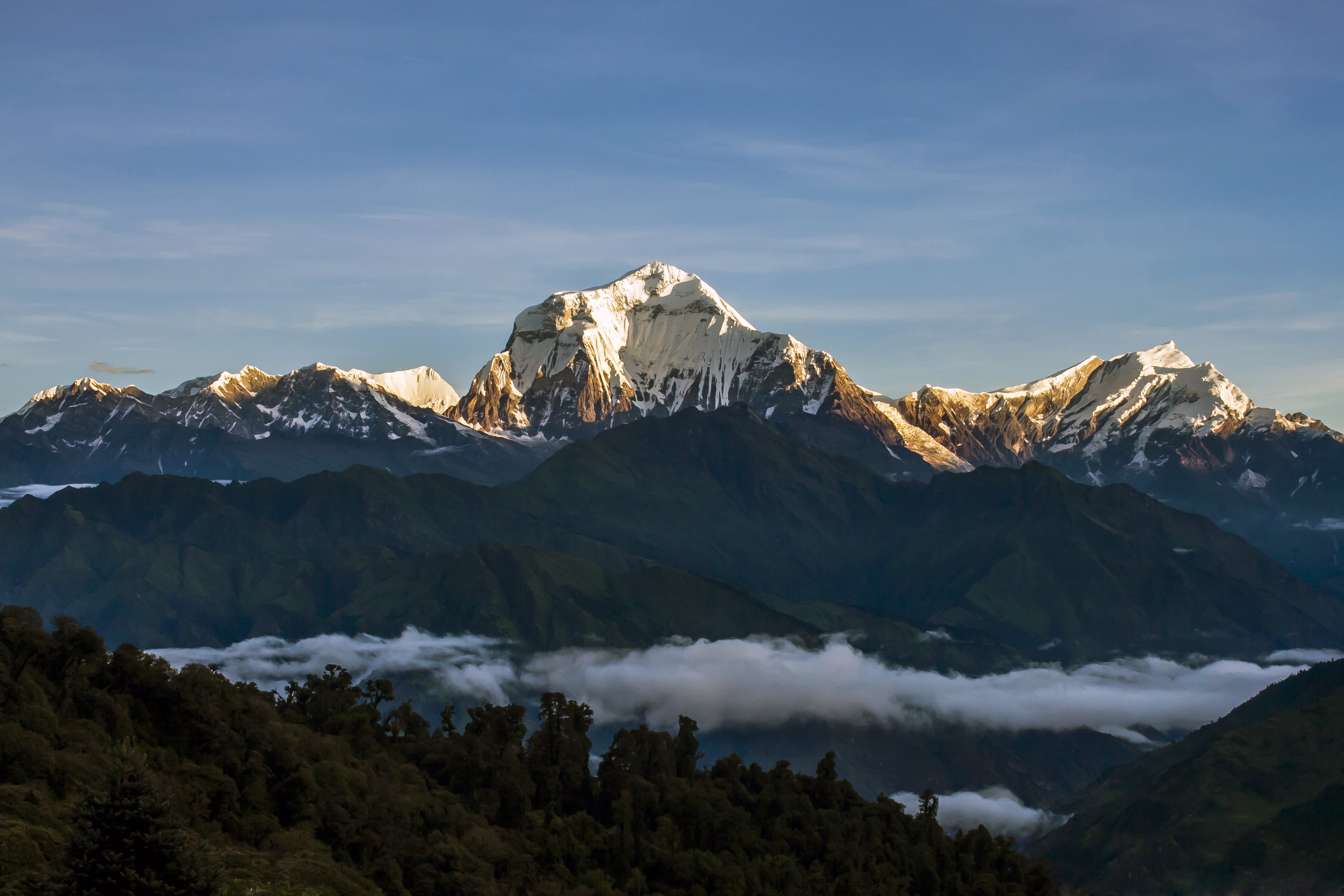
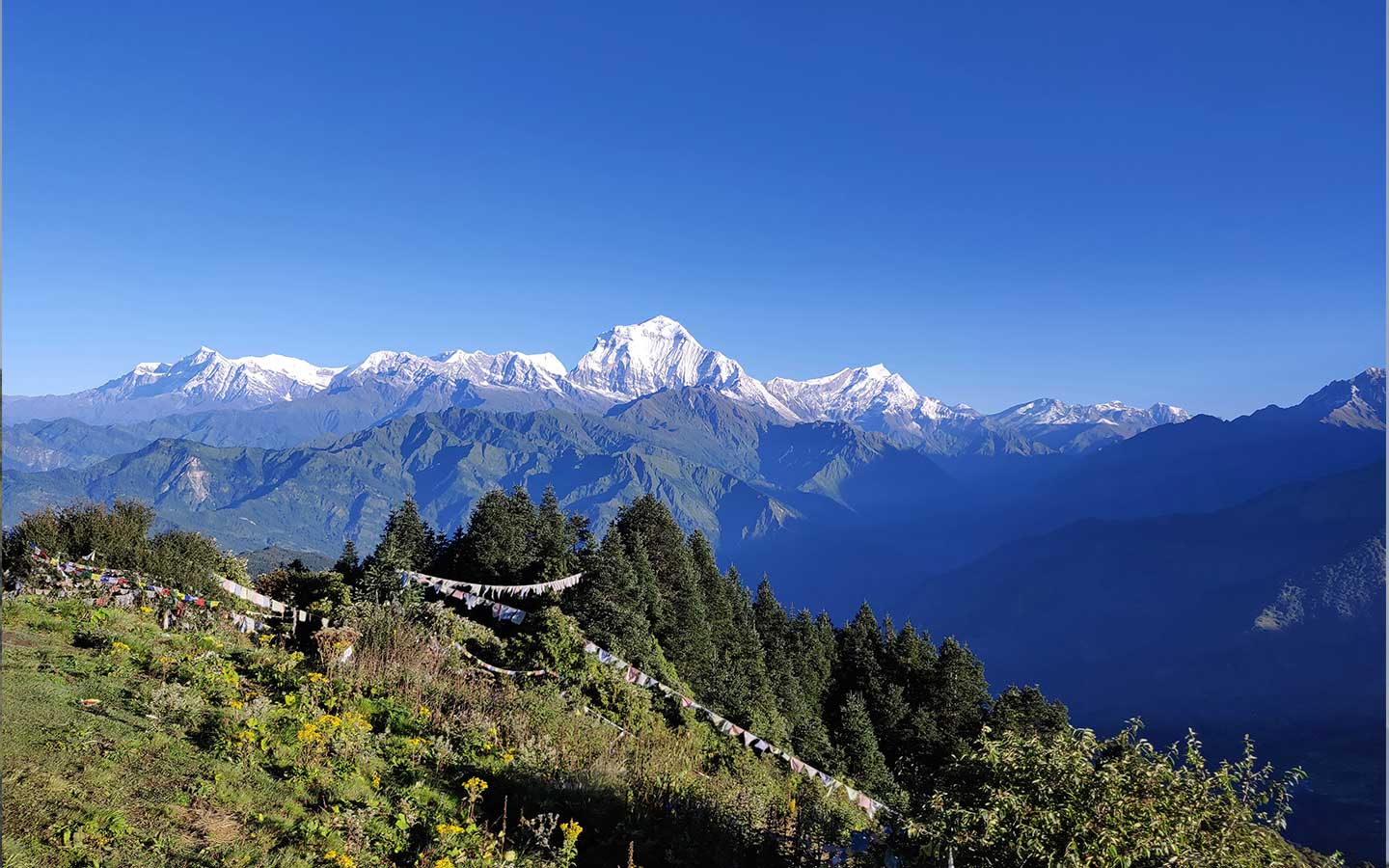
The Ghorepani Poon Hill Ghandruk Trek is one of those routes that manages to pack a lot into a short window. Over 7 days, you will cover somewhere between 45 and 55 kilometers through Nepal’s Annapurna Conservation Area, reaching up to 3,210 meters when you reach the Poon Hill viewpoint for its famous sunrise.
It’s a trek that gets recommended constantly for good reason — you get sweeping views of Annapurna I, II, III, IV, Machhapuchhre, Dhaulagiri, and Mardi Himal, without needing weeks off work or a high tolerance for altitude.
The trail itself tells a story as you walk it. You start by climbing into Ulleri via roughly 3,000 stone steps — the toughest single stretch on the whole route — then continue up through forest to Ghorepani. Here, the pre-dawn hike to Poon Hill happens the next morning. From there, the trek winds down through Tadapani into Ghandruk, a Gurung village known for its stone-paved paths, traditional homes, and some of the clearest, closest views of the Annapurna Sanctuary. Along the way, you will also pass through Tamang settlements, adding another layer to what’s already a culturally rich walk.
What makes this trek worth choosing isn’t just the scenery — it’s how manageable the whole thing is. This is genuinely one of the more beginner-friendly treks in the Annapurna region, and many people use it as a warm-up before tackling something bigger like Annapurna Base Camp or Everest Base Camp later on. No technical climbing, no camping gear needed, and teahouses (plus the option of a proper homestay in Ghandruk) the entire way.
Why This Trek Works So Well
A few things make this route stand out, especially if you’re weighing it against other options in the region:
- You get three experiences in one trip. Most short Annapurna treks give you a viewpoint or a village stay — this one gives you both. Poon Hill’s sunrise is the headline moment, but Ghandruk’s homestays and Gurung culture end up being just as memorable for many trekkers.
- It’s genuinely low-altitude. At 3,210 meters, Poon Hill sits well below the altitudes where serious sickness becomes a real concern. That doesn’t mean you skip acclimatization altogether, but it does mean this trek is accessible to a much wider range of fitness levels and ages than most Himalayan routes.
- Every night, you’ve got a proper bed. Two nights in a 3-star hotel in Pokhara, five nights in teahouses along the trail — no tents, no sleeping on the ground.
- It doubles as training. If Annapurna Base Camp or Everest Base Camp is in your bucket list, this trek is a smart, lower-stakes way to see how your body handles multi-day walking and moderate elevation before committing to something bigger.
Difficulty Level: An Easy-to-Moderate Himalayan Trek
The Ghorepani Poon Hill Ghandruk Trek is rated easy to moderate. This puts the trek well within reach of a reasonably fit beginner. However, it’s still a multi-day trek and shouldn’t be treated casually. A few things shape the difficulty:
- The roughly 3,000 stone steps into Ulleri are a genuine test early on and the toughest single stretch on the whole route.
- Daily walking runs 6 to 7 hours over natural, sometimes rough terrain.
- Altitude isn’t the main concern here the way it would be on a higher route, but hydration and a steady pace still matter, especially heading into Poon Hill.
- The pre-dawn start for the Poon Hill sunrise means an early wake-up on limited sleep.
- Weather above Ghorepani can shift quickly, which is part of why the sunrise hike starts before dawn.
If you have got a basic level of general fitness and you are willing to walk at a sensible pace rather than rush, you will be fine. It’s precisely why this trek gets recommended so often as a first Himalayan trek or as solid preparation before something more demanding like Annapurna Base Camp or Everest Base Camp.
Food and Sleeping on the Ghorepani Poon Hill Ghandruk Trek
You will be staying in three-star hotels in the cities, while teahouses and homestays welcome you on the trekking trails. Food is hygienic and nutritious, supporting you throughout your hike.
Pokhara
You are staying in a proper hotel here — twin-sharing rooms, daily breakfast included, and the freedom to pick your own restaurant for lunch and dinner in the city.
On The Trail (Tikhedhunga to Ghandruk)
Once you leave Pokhara, things get simpler but no less welcoming. Teahouses and lodges give you a basic room — twin beds, clean sheets, and warm blankets. You will want to bring your toiletries, since soap, towels, and toilet paper aren’t always provided. In Ghandruk specifically, you have got the option of staying in a homestay with a local family, which is one of the more memorable parts of this trek for many people.
What You Eat
Dal bhat is the trail staple — rice, lentils, spinach, gundruk, pickles, and sometimes meat, with refills usually included. Beyond that, you will find a limited but decent spread of momos, chowmein, pizza, and burgers along the trail. Hot drinks like tea, coffee, and hot chocolate are available throughout, though they aren’t part of the package price, so budget for those separately.
Ghorepani Poon Hill Ghandruk Trek Transportation Guide
The Standard Way: The package includes tourist bus transfers between Kathmandu and Pokhara — roughly 200 kilometers, taking 6 to 7 hours. From Pokhara, a shared jeep or public vehicle takes you to Nayapul, the trailhead. Likewise, the return leg from Ghandruk back to Pokhara — around 57 kilometers, roughly 2 hours — runs the same way.
The Reality: Road travel in Nepal is slow due to the roads being in different conditions. Not all are pitched. Expect a scenic, unhurried ride rather than a rushed transfer.
The Upgrade: If you’d rather take some time off the road, flights between Kathmandu and Pokhara are available for an additional $100 per one-way sector. This cuts your travel time significantly, to roughly 25 minutes in the air.
Group Size, Porters, and Guides
Guides: All treks are accompanied by licensed English-speaking guides. We pay their wages, meals, insurance, and accommodation for the duration of the trip. Your guide manages permits, sets the daily pace, and watches for anyone struggling on the Ulleri climb or the push to Poon Hill.
Porters (Optional): A porter is available as an add-on, shareable between two trekkers. Hiring one means trekking with just a light daypack while your duffel bag travels separately. Most trekkers have shared with us that they found it comfortable and easy, specifically on the Ulleri climb because they had hired porters.
Solo Traveler? No problem. This itinerary runs for solo trekkers, pairs, and larger groups alike, with per-person pricing dropping as group size increases.
Prefer Privacy? Private departures can be arranged for couples, families, or friends traveling together, and the itinerary can be adjusted to 4, 5, or 6 days depending on your schedule.
Note: Whatever your group size, let us know your preferred travel dates, and we handle the rest. This includes permits, teahouse and homestay bookings, and transport.
Why Trek Ghorepani Poon Hill Ghandruk With Radiant Treks
- Guides who know the route — walked it dozens of times, know the pace, know the tricky bits
- Every ride sorted — airport pickup, Pokhara transfer, the jeep to Nayapul, all booked ahead
- Rooms locked in — hotel in Pokhara and teahouses along the trail, no scrambling for a bed
- Meals covered — breakfast, lunch, dinner, every day on the trail
- No permit hassle — ACAP sorted before you arrive, you just walk through
- Gear included — down jacket, sleeping bag, duffel bag, no need to buy or rent
- Crew looked after — guide pay, insurance, food, lodging, all covered on our side
- First aid on hand — guide carries a kit, rescue gets arranged fast if needed
- No hidden costs — the price you see is the price you pay
- A little keepsake — company t-shirt at the end, nothing fancy
Itinerary
Drive duration: 6-7 hours
We start our 1st day of Ghorepani Poon Hill Ghandruk trek with a scenic 7-8 hour drive to Pokhara passes through the winding highways of the hilly green landscapes. After arriving at Pokhara, you will get transferred to the hotel in Lakeside, Pokhara.
After lunch, we will go on a sightseeing tour of the Lakeside area. We can also visit the famous Tal Barahi Mandir and go on a boating tour of Lake Phewa. You can stroll around and observe the beautiful Lakeside beach, cafes, pubs, and others. Overall, the vibrant atmosphere of the place will enchant you. You will stay overnight at the hotel in Pokhara.
Drive duration: 2-3 hours
After breakfast, we start our drive to Hile via Nayapul. The scenic drive takes you along the green landscapes of the hilly region. The tour is incredibly beautiful, and you can observe the majestic mountains from the window.
Moreover, the view of the snow-capped mountains from the various stops along the trip is awe-inspiring. It takes around 2 hours to complete the journey. After arriving at Hile, you can rest and stay overnight at a lodge.
Maximum altitude: 2860 m
Trek duration: 6-7 hours
After breakfast, we will start our trek to Ghorepani (2860 m) from Hile. The trail passes through the scenic landscapes of the pristine region. We pass through the scattered settlements of the region before arriving at Ghorepani.
Moreover, we need to cross the famous Ulleri stone stairs along the trail. It takes around 6-7 hours to complete this stunning trek. The forested trails of lush alpine forest finally leads us to Ghorepani. We will stay overnight at a community-run teahouse in Ghorepani.
Maximum altitude: 3210 m
Trek duration: 7-8 hours
After an early breakfast, we start our 45 minutes hike to the spectacular Poon Hill viewpoint (3210 m). We can observe the stunning sunrise view from the viewpoint. You can watch the awe-inspiring sun rays falling over the snow-capped mountains in all its glory.
We started our descending trek from Ghorepani after observing the sunrise view and taking incredible pictures. We then descend back to Tadapani (2,630m) from Ghorepani. The downhill trek is easy, and you can enjoy the trek with ease. Besides that, the beautiful waterfalls and vast orange orchards of the region will enchant you.
Moreover, you can also taste the local oranges along the way. We will arrive at the settlement of Tadapani after a trek of around 4 hours. We will stay overnight at a teahouse in Tadapani.
Maximum altitude: 2630 m
Trek duration: 3 hours
After breakfast, we will start our trek from Tadapani to the famous settlement of Ghandruk (2010m). Ghandruk is a beautiful Gurung settlement with local homestays. We will descend observing the snow-capped mountains of Annapurna I and Mt. Machhapuchhre to arrive at our destination.
Moreover, the vast green mustard fields and orange orchards will enchant you. You can also taste the local oranges along this short 3 hours trek. The 6 km trek is a pleasant experience. We will arrive at this incredible village situated next to the Himalayas. After arriving at Ghandruk, we can explore the beautiful cultural settlement.
Furthermore, the culture, tradition, and lifestyle of the settlement will enchant you. There you can observe the Gurung people busy on their farms. You can also observe the traditional instruments like Dhiki, Jato, and Theki. We can enjoy a traditional welcoming ceremony and dance performed by the local Gurung community. We can enjoy the delicious dinner in the evening and stay overnight at the homestay in Ghandruk.
We will observe the beautiful Himalayan sunrise from the viewpoint in Ghandruk. The breathtaking sunrise overlooking the snow-capped mountain will enchant you. After breakfast, we will start our trek from Ghandruk to Nayapul.
Moreover, the descending trail takes you through the terraced farmed hills and village settlements to arrive at Nayapul. We have our lunch at Nayapul and continue our drive to Pokhara. After arriving at Pokhara, you can observe the vibrant atmosphere of the tourist hub of Lakeside in Pokhara. We will stay overnight at a hotel in Pokhara.
After breakfast, we will start our drive from Pokhara to Kathmandu. It takes around 6-7 hours to complete the drive along the winding hilly roads. We will celebrate the completion of this beautiful tour with dinner in the evening.
Trip Cost Details
Cost Includes
- Airport transfer services, including pick-up on arrival and drop-off at departure
- Tourist bus transportation between Kathmandu and Pokhara (optional flight upgrade available at extra $100 per one-way trip)
- Local transportation by public bus or jeep from Pokhara to Nayapul and from Ghandruk back to Pokhara
- Two nights’ accommodation in a 3-star hotel in Pokhara on a twin-sharing basis, including daily breakfast
- Five nights’ accommodation in teahouses along the trekking trail
- Full-board meals during the trek (breakfast, lunch, and dinner), with fresh fruit served after dinner
- Annapurna Conservation Area Permit (ACAP)
- Services of a licensed, experienced, English-speaking trekking guide
- All guide-related costs, including wages, meals, insurance, and lodging
- Basic first aid supplies for emergency use
- Emergency rescue arrangements if required (rescue and evacuation expenses to be paid by the trekker or their insurance provider)
- Complimentary company T-shirt as a keepsake
- Use of trekking gear including a duffel bag, sleeping bag, and down jacket during the trek (to be returned after completion)
- Printed trekking route map
- All applicable government taxes, service fees, and official charges
Cost Excludes
- Porter service (at extra $140, shareable between two trekkers)
- Lunches and dinners while staying in Pokhara
- Meals and accommodation in Kathmandu
- Personal expenses such as laundry, snacks, and miscellaneous items
- Extra fees at teahouses for hot showers, Wi-Fi, and battery charging
- Personal trekking gear and clothing
- Travel insurance covering trekking activities and emergency evacuation
- Additional costs arising from unforeseen circumstances, including flight delays, cancellations, bad weather, or similar events
- Tips and gratuities for guides, porters, and support staff
- All drinks, including bottled water, tea, coffee, soft drinks, and alcoholic beverages
- Sightseeing tours or optional activities in Kathmandu and Pokhara
Essential Info: Ghorepani Poon Hill Ghandruk Trek Guide
Trek Basics & Essential Info
Think of it as three highlights in one short trip. You walk through the village of Ghorepani, catch sunrise from Poon Hill, then wind down through Ghandruk's Gurung villages. It's set inside the Annapurna region, and most people finish it in under a week without needing any serious trekking background.
You are inside the Annapurna Conservation Area, starting and finishing near Pokhara. The route follows the Modi Khola valley on the way up, then loops back through Ghandruk. It's one of the more accessible parts of the Annapurna region, which is partly why so many first-time trekkers end up choosing it.
Most people go with the standard 7-day package, which already includes your Kathmandu-Pokhara travel. You are not looking at the two-plus weeks longer Annapurna routes demand.
Over the full trip, you will cover somewhere between 45 and 55 kilometers. Daily distances stay fairly reasonable, usually 6 to 10 kilometers depending on the day. Nothing here compares to the long, grinding days you'd get on a trek like Manaslu Circuit or Everest Base Camp.
That's Poon Hill, sitting at 3,210 meters. Compared to Annapurna Base Camp or Everest Base Camp, this is genuinely low altitude. Most trekkers won't feel much beyond mild breathlessness, and altitude sickness risk stays fairly minimal throughout the entire route.
It's built right into the standard itinerary, not tacked on afterward. Most itineraries have you spending a night here, often with the option of staying in a local homestay, before heading back down to Pokhara the next morning.
The sunrise from Poon Hill is the obvious headline, with Annapurna I, II, III, IV, Machhapuchhre, Dhaulagiri, and Mardi Himal all visible from the viewpoint. But the trek offers more than one moment. Ghandruk's Gurung culture, the Ulleri stone steps, and the option of a homestay round out what's actually a fairly complete Himalayan experience in under a week.
Mainly, it's shorter and lower. Annapurna Base Camp pushes well past 4,000 meters and takes several extra days. This trek never goes above 3,300 meters, so you get a real taste of the Annapurna region without committing two full weeks.
Honestly, yes. It's one of the more forgiving routes in Nepal for someone testing the waters. The altitude stays manageable, the days aren't brutally long, and there's no technical climbing involved anywhere along the trail.
With decent fitness, generally yes. Families choose this route fairly often, mostly because the altitude stays low and the daily walking hours aren't excessive. That said, every kid is different, so it's worth being honest about your child's stamina beforehand.
Booking, Payment & Trip Policies
Tell us your dates and how many people are coming. We confirm the spot, then you pay a 20% deposit. That's what gets your permits, teahouse rooms, and transport locked in.
No. Once it's paid, it's non-refundable. We use it right away to secure your bookings, so there's nothing left to give back.
The balance is due once you land in Kathmandu, before the trek starts. Cash or card both work. A few people just pay it all upfront, which is fine too.
Please note that a 4% bank processing fee is added to all card payments. This fee is charged by the payment processing system/bank and is added to the total payment amount.
Write to us first. Cancel within 7 days of departure and you're looking at a 30% fee. The deposit's non-refundable either way.
Often, yes, especially if it's a real emergency. You'd cover whatever we have already spent, plus the difference if your new dates cost more.
This doesn't happen often, but if a strike or disaster forces a cancellation, we will offer a similar trip elsewhere. If there is no good alternative, you will receive a refund, minus the processing fee.
We start processing your refund within 5 working days of hearing from you. It goes back the way you paid. Bank charges on that end are yours to cover. For more details, check our terms and conditions and cancellation policy.
Rarely, but fuel or currency shifts can push costs up. If that happens, you'd settle the difference before the trek begins.
Arrival & Kathmandu/Pokhara Services
Airport transfers are part of the package, both on arrival in Kathmandu and at departure. There's no need to arrange a taxi or work out directions in an unfamiliar city right after landing at Tribhuvan International Airport. Meals and hotel stays in Kathmandu aren't included, so trekkers must arrange them on their own.
A tourist bus covers the roughly 200-kilometer stretch to Pokhara, and the ride usually takes six to seven hours. Road conditions in Nepal aren't always smooth, so it's worth treating the drive as part of the experience rather than expecting a quick hop. The hills along the way make for a decent first look at the country.
For an extra $100 per one-way sector, trekkers can skip the road entirely and fly instead. The flight itself takes around 25 minutes, compared to several hours by bus. It's a useful upgrade for anyone working with limited vacation days or who'd simply rather not spend a full day in transit.
Two nights in a three-star hotel are included, on a twin-sharing basis, with breakfast provided each morning. These stays sit at either end of the trekking portion of the trip. Lunch and dinner aren't covered, which works out fine since Pokhara has plenty of restaurants worth exploring on foot.
Lakeside Pokhara is easy to spend a day or two in — cafes, small shops, and a walking path along Phewa Lake. A boat ride out to Tal Barahi Temple is a common stop. This downtime also happens to help with acclimatization before heading up toward the trail.
A shared jeep or public vehicle takes trekkers from Pokhara to Nayapul, where the actual walking begins. Coming back, the same kind of transport handles the return leg from Ghandruk to Pokhara, a trip of about 57 kilometers that takes roughly two hours.
Not quite — transportation and airport pickup in Kathmandu are covered, but food and hotel stays there are not. Most trekkers book accommodation in the capital for the nights before and after the trek, giving them more control over budget and location.
Both are right there at arrivals. So, there's no need to go looking for either once you are in the city. A few telecom counters sell tourist SIM cards with data included, and currency exchange counters sit close by too. Most people knock both out before even leaving the terminal.
Usually, yes. Most hotels will hold onto anything you don't need on the trail- city clothes, laptops, or whatever. Worth double-checking with your specific hotel before heading to Pokhara, just so there's no confusion about pickup later.
There's flexibility here. If you want a few extra days in Pokhara or fancy tacking on a short tour somewhere else in Nepal, that can be worked into the plan. Just mention it early on, and it's easier to fit around the existing bookings.
Visa, Permits & Rules
Yes, most nationalities need a visa to enter Nepal, and this is separate from the ACAP permit required for the trek itself. Visas are typically available on arrival at Kathmandu's airport for a fee, payable in cash or by card, though requirements vary by nationality. You might want to check the requirements of your specific country before you leave.
Since the route runs entirely within the Annapurna Conservation Area, trekkers need the ACAP permit. Radiant Treks includes the permit in the package cost. There's nothing extra to arrange or pay for separately. The paperwork gets sorted before you even reach the trailhead.
The responsibility falls to Radiant Treks once your dates and group size are confirmed. We handle teahouse bookings and transport in the same process. You won't be chasing down forms or standing in permit queues. It's one of the quieter benefits of going through an operator.
The area is a protected zone, home to significant wildlife and forest cover alongside long-established village settlements. The authorities concerned use the fee collected from the permit to support conservation initiatives and community development in the area. Think of it less as red tape and more as a contribution toward keeping the trail intact.
Technically, yes. The trails here are well marked, and solo trekking is considered reasonably safe. Still, most people opt for a guide anyway. Beyond safety, guides manage permit logistics and pacing, and they know the terrain better than any map could show. Most operator packages include one by default.
No camping is involved on this route, since teahouses and homestays cover every night's stay. Trekkers are advised to follow the existing trail between Tikhedhunga, Ghorepani, Poon Hill, Tadapani, and Ghandruk. Straying off marked trails isn't really part of how this trek works, for safety and environmental reasons alike.
Kathmandu and Pokhara both have gear shops renting out sleeping bags, down jackets, poles, and that sort of thing, usually at fair daily rates. Though with this package, a duffel bag, sleeping bag, and down jacket are already included, so renting really only comes up for anything extra you might want.
Yes, it's part of what you get with the standard package: a printed map covering the route from Tikhedhunga through Ghorepani, Poon Hill, Tadapani, and on to Ghandruk. It's handy to have, but it's really just a reference. Out on the trail, the guide's knowledge counts for a lot more than any map does.
Not really. The ACAP applies year-round, no matter when you decide to go. What actually changes with the seasons is trail conditions and weather, not the paperwork. Winter, monsoon, spring, autumn — the permit requirement doesn't budge either way.
Keep a copy of your ACAP permit on you at all times, ideally in your daypack rather than buried in a duffel bag. Your passport and travel insurance details are also worth having close by. Checkpoints along the route may ask for these, and emergencies don't wait for you to dig through luggage.
Difficulty, Training & Fitness
This trek is rated easy to moderate, making it accessible to reasonably fit beginners. It's still a multi-day trek, so it shouldn't be treated too casually. Daily walking runs six to seven hours over natural terrain. The roughly 3,000 stone steps into Ulleri are the toughest stretch on the route.
Not really. Many first-time trekkers choose this exact trail for that reason. No technical climbing skills are required anywhere along the way. A basic level of fitness matters more than prior experience. Walking at a sensible pace, rather than rushing, makes the most significant difference.
Regular cardio in the weeks beforehand helps considerably, especially stair climbing or hill walking. Building leg strength makes the Ulleri stone steps far more manageable. A few practice hikes with a loaded daypack won't hurt either. Overall fitness matters more here than any specialized mountain training.
The stone staircase leading into Ulleri stands out as the hardest single stretch. It comes early, on day two of the standard itinerary. Trekking poles help considerably on the way up and back down. Beyond that, daily distances stay fairly reasonable, at 6 to 10 kilometers.
Generally, yes, given decent baseline fitness. Families choose this route often because the altitude stays low. Daily walking hours also stay within a manageable range. That said, every child or older trekker is different. It’s wise to be honest about your own personal stamina before you commit to the full itinerary.
Beginners complete this trek regularly, and it's often recommended as a first Himalayan trek. That said, arriving with zero physical preparation isn't advisable either. A basic fitness baseline, plus a willingness to walk at a steady pace, covers most of what's needed. Rushing the pace is what causes the most difficulty.
Yes, it's widely used this way. The moderate elevation and multi-day walking give a useful preview of longer treks. It shows how your body reacts to long walks as well as elevation.
Best Time & Weather
Autumn and spring are generally considered the strongest windows for this trek, mainly because both bring stable weather and comparatively little rain. Autumn spans September through November, and spring runs March through May. On the trail, the two seasons feel quite different, but either one works well for this particular route.
Conditions change quite a bit depending on where you are on the trail. Lower villages near Nayapul stay fairly warm, while the Poon Hill viewpoint gets close to freezing, especially before sunrise. Here's a season-by-season breakdown of what to expect.
| Season | Temperature Range & Weather Conditions |
| Autumn (Sep - Nov) | Daytime hovers around 15°C to 20°C lower down, dropping to near 0°C to 5°C at night, and is colder still up at Poon Hill. Skies stay clear more often than not, and autumn is generally the season with the fewest weather surprises. |
| Spring (Mar-May) | Days run warmer, roughly 12°C to 18°C, while nights dip to 2°C to 7°C depending on elevation. The weather holds up well overall, though afternoons occasionally turn hazy. Rhododendrons and wildflowers are in full bloom this time of year. |
| Summer/Monsoon (Jun-Aug) | Warm and humid, with daytime temperatures often between 20°C and 25°C and nights rarely dropping below 10°C. Rain is frequent, trails get muddy and slippery, and leeches turn up in the lower forested stretches. Mountain views are hit or miss. |
| Winter (Dec-Feb) | Daytime temperatures sit between 5°C and 12°C, but nights can fall well below freezing, sometimes to -5°C near Poon Hill. Snow shows up occasionally at higher points. Skies tend to stay clear during the day despite the cold. |
This is usually the season people picture when they imagine the trek — clear skies, crisp air, and mountains that seem to stand right in front of you. Temperatures stay moderate rather than extreme. It also lines up with festival season in Nepal, so villages along the way tend to feel more lively than usual.
Spring has its own appeal, mostly thanks to the rhododendrons and wildflowers that cover the hillsides in shades of pink and red. The weather holds up reasonably well through these months, though afternoons can get a bit hazy. You'll also notice more wildlife activity as animals come out after winter.
It's possible, but not really recommended if mountain views matter to you. Rain during the summer months makes the trail slippery, and leeches show up in the wetter, lower sections. Some trekkers still go during this window for the quieter trails, but visibility usually suffers.
Yes, and it's more manageable here than on higher-altitude treks, since Poon Hill only reaches 3,210 meters. Expect cold mornings and the occasional snowfall, particularly near the top. As long as you are packed properly for the cold, there's no real reason this trek can't be done in winter.
It does, more than people expect. Mornings above Ghorepani can be clear one hour and clouded over the next, which is precisely why the hike starts in the dark, well before sunrise. Getting up early isn't just tradition — it genuinely improves your odds of catching the view before clouds roll in.
Accommodation & Food
Lodging changes depending on where you are in the trip. In Pokhara, trekkers stay in a three-star hotel on a twin-sharing basis for two nights. On the trail itself, it's teahouses and lodges, with the option of a proper homestay with a local family once you reach Ghandruk.
Don't expect luxury, but they are comfortable enough. Rooms generally are furnished with twin beds, fresh sheets, and warm blankets. Hot water and Wi-Fi sometimes cost a little extra depending on the lodge. It's worth packing your own toiletries, since soap and towels aren't always provided.
Yes, and it's one of the more memorable parts of the trip for many people. In Ghandruk, trekkers have the option of a homestay instead of a regular teahouse. You get a firsthand look at Gurung culture and daily village life, which a standard lodge simply can't offer.
Dal bhat is the staple you will see almost everywhere — rice, lentils, spinach, gundruk, and pickles, often with a side of meat. Refills are usually included, which helps on longer walking days. Beyond that, there's a decent spread of momos, chowmein, pizza, and the occasional burger.
Vegetarian meals aren't a problem anywhere along this route; dal bhat on its own is basically plant-based already. Vegan, gluten-free, or allergy-related requests get trickier the higher up you go, since teahouse kitchens are small and options are limited. Best to flag anything specific to Radiant Treks ahead of time so the guide can plan around it.
No, drinks are handled separately from the main package cost. Tea, coffee, hot chocolate, and similar hot drinks are available at every stop, but they're paid for individually. And the same applies to bottled water and any alcoholic drinks, so it’s worth budgeting a little extra for these.
Generally, yes. Teahouses and lodges serve fresh and healthy food to the trekkers. This is important, as trekking needs lots of physical stamina. That said, it's still sensible to drink treated or purified water rather than tap water, just as a precaution.
It's strongly recommended, and Radiant Treks arranges these services as part of the standard package. Pre-booking food and lodging along the route avoids the uncertainty of showing up to a full teahouse during peak trekking season. This option is one of the practical reasons most trekkers choose to book through an operator rather than arranging things independently.
A universal adapter handles all kinds of sockets, so there's no need to guess which one you will actually need. Bring it with you rather than counting on finding the right type once you're in Kathmandu, let alone somewhere up the trail.
Cost, Money & Transport
The package covers quite a bit: airport transfers, tourist bus transport between Kathmandu and Pokhara, two hotel nights in Pokhara with breakfast, five teahouse nights on the trail, full-board meals, the ACAP permit, a licensed guide, basic first aid, and use of trekking gear like a duffel bag, sleeping bag, and down jacket.
Porter service, meals in Pokhara beyond breakfast, all meals and lodging in Kathmandu, travel insurance, drinks of any kind, and personal expenses like laundry or Wi-Fi charges all need to be covered separately. Tips for guides and porters aren't included either.
Cash matters more than people expect once you are past Pokhara. ATMs become scarce the higher you go, and teahouses along the route generally don't accept cards. It’s worth taking enough Nepali rupees for all meals, drinks, hot showers, and tips for the whole trek.
Yes, a handful of small charges add up along the way. Hot showers, Wi-Fi, and battery charging often come with a small fee at higher-altitude teahouses, since resources get harder to bring up the mountain. None of these costs are large individually, but it helps to plan for them.
Guides & Porters
It does. Every booking comes with a licensed, English-speaking guide, and the price you pay already includes their wages, meals, insurance, and lodging. Nothing extra to sort out there. Beyond translating and answering questions, the guide is also the one keeping permits in order and setting a pace the whole group can actually handle.
More than just walking ahead and pointing out the trail, a guide also manages permits and adjusts the pace to match the group's needs. That is true, especially on challenging sections like the Ulleri stone steps. There's also the local knowledge a guide brings, the kind you won't find printed on any map.
Not strictly necessary, but it makes a real difference in comfort. A porter service is available as an optional add-on, shareable between two trekkers, for an extra $140. Hiring one means trekking with just a light daypack while the rest of your gear travels separately in a duffel bag.
Duffel bags handed off to porters should stay around 12 kilograms, which keeps things manageable alongside the porter's own gear. Trekkers who've hired porters, especially for the Ulleri climb, generally describe the experience as far more comfortable than carrying a full pack solo.
Technically, it is a possible option. The trails are well marked, and solo trekking here is considered pretty safe compared to most routes in the region. But in practice, most people don't go that route. A guide takes care of the permits, keeps the pace reasonable, and adds cultural context you just don't get when walking alone with a map.
Absolutely. The itinerary runs for solo trekkers, pairs, and larger groups alike, with per-person pricing dropping as group size increases. Solo travelers aren't grouped with strangers unless they want to be, and the guide-and-porter setup works the same regardless of group size.
Yes, private departures can be arranged for couples, families, or groups of friends traveling together. The itinerary itself is also flexible and can be adjusted depending on scheduling needs, rather than sticking strictly to the standard 7-day format. All you need to do is tell us about your needs, and Radiant Treks tweaks the package accordingly.
Safety & Altitude
Not really, at least not compared to higher routes. Poon Hill tops out at 3,210 meters, which sits well below where serious altitude sickness typically becomes a risk. Mild breathlessness is about as far as most trekkers feel it. That said, basic acclimatization habits are still worth keeping up.
Staying hydrated and keeping a steady, unhurried pace are the most important things you can do. Rushing between stops is really the main thing that causes trouble on a trek like this. Some trekkers also carry anti-nausea tablets like Diamox as a precaution, though at this altitude range, it's rarely a necessity.
Tap water isn't something to rely on directly. Most trekkers carry water purification tablets or a small filter, refilling from local sources rather than buying bottled water the whole way. It's a more practical habit anyway, since bottled water gets harder to dispose of responsibly the further you get from Pokhara.
Guides typically carry a group first aid kit, and it's still worth having a personal one too. For anything more serious, emergency rescue can be arranged, though the cost of evacuation itself falls on the trekker or their insurance provider. This is precisely why travel insurance covering trekking activities matters here.
Yes, and it is one to be taken seriously. It is not mandatory, but it is a smart move to get travel insurance covering trekking activities and emergency evacuation before departure. Given that rescue costs aren't covered otherwise, skipping this step isn't really worth the risk it creates.
A few basics cover most situations: pain relief, something for stomach upset, and rehydration salts. Blister care matters more here than people expect, given how much of the trail runs over stone steps and uneven ground, so plasters, blister tape, and antiseptic cream are worth packing.
Generally, yes. The trail sees heavy use, and teahouses along the route welcome travelers of all kinds. That said, many solo female trekkers still choose to bring a guide. The reason is that they seek added comfort and support, rather than any specific safety concern tied to the route itself.
Culture, Nature & Responsible Travel
You will pass through both Gurung and Tamang villages on this route. Ghandruk is the standout Gurung settlement — stone paths, old-style houses, that sort of thing. The Tamang communities show up earlier on the trail, before you even reach Ghorepani, and they add a different flavor to the walk than what you'll find further along.
Ghandruk is really where this happens. Trekkers can opt for a homestay instead of a regular teahouse, which means actually staying with a family rather than just passing through. Some groups get treated to a welcoming dance or small ceremony. It's one of those things that sticks with people longer than the mountain views do, oddly enough.
This whole trek sits inside the Annapurna Conservation Area, so there's a fair bit of forest along the way. Go in spring, and the rhododendrons are impossible to miss. They cover entire hillsides in red and pink. Don't expect major wildlife sightings, though. It's more about walking through the landscape than spotting animals in it.
Stay on the marked trail, skip the bottled water in favor of purification tablets, and don't leave plastic behind on the mountain. In villages, it helps to just be mindful — ask before taking someone's photo, that kind of thing. Small courtesies matter more in a place like Ghandruk than they might elsewhere.
Part of what you pay for the ACAP permit goes back into the region itself, funding conservation efforts and community projects. So it's not just a fee for entry. It's tied to keeping the forests and villages here in the kind of shape that makes people want to keep coming back.
Keep an eye out for tools like the Dhiki, Jato, and Theki — still in use in parts of the village, not just museum pieces. Farming is still very much part of daily life here too, so don't be surprised to see people working the fields right alongside the trail.
Yes, and it's genuinely appreciated, though nobody's going to pressure you into it. For many guides, porters, and homestay families, tourism income matters. A modest tip goes further than something showy. If you're unsure what's reasonable, just ask your guide — they will know the going rate better than any guidebook will.
Trek Comparisons
The main difference is mostly altitude and duration. Annapurna Base Camp pushes well past 4,000 meters and takes several extra days to complete. This trek tops out at 3,210 meters and wraps up in a week. Many people actually use Poon Hill as a warm-up before attempting ABC later on.
Both are considered fairly approachable, but Poon Hill edges ahead slightly for first-timers. The Mardi Himal trek is a bit higher and involves steeper, more exposed sections in places. Poon Hill sticks to a gentler learning curve overall, with the Ulleri steps being about the only real physical test on the route.
There's really no comparison in terms of scale. Everest Base Camp takes around two weeks and climbs to over 5,000 meters, with real altitude risk involved. Ghorepani Poon Hill Ghandruk stays low and short by comparison, which is precisely why it works as practice before something like EBC.
These two aren't really aimed at the same trekker. The Manaslu Circuit is a longer, more remote route with a high-pass crossing and restricted-area permits involved. This trek is shorter, easier to arrange on short notice, and doesn't demand the same level of prior trekking experience or gear.
Most short treks in the region give you either a viewpoint or a cultural village stay, rarely both. This one combines the Poon Hill sunrise with a proper homestay experience in Ghandruk, which is part of why it gets recommended over some of the other quick trekking options nearby.
It works well as a substitute, yes. You still get the Annapurna Conservation Area scenery, mountain views, and cultural exposure, just compressed into a week instead of two. It won't replace the sense of scale a longer trek offers, but for limited time, it captures a good deal of what the region is known for.
Ghorepani Poon Hill Ghandruk Trek Packing List
This trek is shorter and lower altitude than something like Annapurna Base Camp, topping out at just 3,210 meters. That makes packing more forgiving overall. But the temperature range you will actually experience — from warm lower villages near Nayapul to a near-freezing pre-dawn climb up Poon Hill — still calls for a proper layering system.
Here’s a full breakdown of what to bring and why each piece earns its place.
Clothing
Base layers: Two to three sets of moisture-wicking thermal tops and bottoms. Skip cotton entirely — it holds sweat and dries slowly, which becomes uncomfortable fast on multi-day treks.
Mid layers: A fleece or light insulated jacket, plus a spare. This trek doesn’t need the heavier mid-layers that higher routes call for, but one solid layer isn’t enough on its own.
Outer shell: A waterproof, windproof jacket, carried regardless of season. Afternoon weather above Ghorepani shifts faster than the morning forecast suggests. Waterproof trousers are a smart addition outside the dry autumn window.
Down jacket: Essential the moment you’re staging for the Poon Hill sunrise. Even in spring or autumn, that hour is properly cold, and a compressible down jacket rated for near-freezing temperatures changes the experience completely.
Everyday wear: Three to four trekking shirts, two to three trekking trousers, and a lightweight pair of shorts for the warmer stretches near Nayapul and Tikhedhunga.
Head and hands: A warm beanie, a sun hat for exposed lower sections, thin glove liners with a warmer outer pair for the sunrise climb, and a buff or neck gaiter for sun and wind protection.
Sleepwear: A separate set of thermal wear reserved just for sleeping keeps you from wearing damp trekking clothes overnight in cold teahouse rooms.
Footwear
The roughly 3,000 stone steps into Ulleri are unforgiving on unbroken-in boots or weak ankle support, and that’s only day two.
Trekking boots: Waterproof, with solid ankle support, and already broken in well before you land in Nepal.
Camp shoes: Sandals or slip-ons let your feet rest each evening and are handy for quick trips to shared bathrooms.
Socks: Four to five pairs of trekking socks, plus one or two warmer wool pairs for cold nights in Ghorepani or Ghandruk. Choose quick-dry fabric over cotton.
Gaiters: Not essential. However, they are useful if you want to keep dust and small stones out of your boots on the drier, dustier lower sections of the trail.
Bags
Daypack: A 25 to 30-liter pack comfortably covers this trek’s shorter daily distances. It should hold water, snacks, a spare layer, and a camera without feeling heavy by hour four.
Duffel bag: Keep the packed weight around 12 kilograms if you’re hiring a porter, so it stays manageable when carried alongside their own gear.
Extras: A rain cover for your daypack, a couple of dry bags for clothing and electronics, and a small daypack organizer or packing cubes to keep things easy to find at teahouses.
Sleeping Gear
Teahouse rooms on this route are simple and unheated, and nights in Ghorepani or Ghandruk get noticeably cold even when daytime temperatures feel mild.
Sleeping bag: Rated to around -5°C to -10°C, which is sufficient for this trek’s altitude range — no need for the heavier-rated bag a higher trek would require.
Sleeping bag liner: Adds a bit of extra warmth and keeps things more hygienic across multiple teahouse stays.
Extras: Earplugs and a sleep mask help with thin walls and early light in shared teahouse buildings.
Toiletries
Essentials: Toilet paper, wet wipes, and hand sanitizer, since teahouses don’t always supply them and prices climb the higher you go.
Skin protection: Sunscreen and lip balm with SPF. UV exposure is stronger than it feels at this altitude, especially on the exposed approach to Poon Hill.
Small extras: A small biodegradable soap, a quick-dry towel, a toothbrush and travel-size toothpaste, nail clippers, and any personal hygiene items you use regularly — these aren’t reliably available once you’re past Pokhara.
First Aid and Medication
Your guide typically carries a group first aid kit, but a personal one is still worth packing.
Useful medicines: Basic pain relief, something for stomach upset, and rehydration salts.
Blister care: Plasters, blister tape, and antiseptic cream matter more on this trek than people expect, given how much of the route runs over stone steps and uneven ground.
Personal items: Enough of your regular prescription medication to cover the full trip, plus a few extra days as a buffer, along with any personal medical items specific to you.
Hydration and Snacks
Water: A reusable bottle in the one to two-liter range covers daily needs.
Purification: Tablets or a small filter, rather than relying on bottled water, which becomes harder to dispose of responsibly the further you get from Pokhara.
Snacks: Energy bars, trail mix, and a bit of chocolate are genuinely worth carrying, especially for the early climb to Poon Hill before breakfast is properly underway.
Trekking Gear, Electronics, and Comfort Items
Trekking gear: Trekking poles help considerably on the Ulleri steps, both climbing up and coming back down. A headlamp with spare batteries is non-negotiable for the pre-dawn Poon Hill hike.
Electronics: Power bank and charging cables (sometimes outlets are limited or charge a small fee in teahouses) Keeping devices inside your sleeping bag overnight helps preserve battery in colder stops like Ghorepani.
Comfort items: Sunglasses with strong UV protection, a small notebook or book for the evenings, and a lightweight travel lock for your duffel bag.
Documents and Cash
Keep your passport, ACAP permit copy, and travel insurance documents in your daypack rather than your duffel, so they stay with you at all times. Cash matters more than people expect once you are past Pokhara. That is so because ATMs disappear quickly, and everything from teahouse bills to tips runs on Nepali rupees.
Real Stories from our TripAdvisor Page
Curious about what travelers say about Radiant Treks? Discover genuine experiences on our Reviews Page.
Ghorepani Poon Hill Ghandruk Trek Route Map

