Most people heading toward the Manaslu region focus on the mountains — the long trails, the passes, and that sense of remoteness. However, this journey often overlooks another layer — the Tsumba people of Manaslu, the people who live here.
Beyond the main Manaslu Circuit trek route lies Tsum Valley, home to the Tsumba people, one of Nepal’s most culturally distinct Himalayan communities. Their way of life reflects the deeper Tsum Valley culture that continues to shape the region.
And instead of tourism, the beliefs, isolation of the community, and continuity of culture have played a role in shaping this place. And understanding the Tsumba people shifts how you experience the entire Manaslu region.
Highlights
- Tsum Valley isn’t shaped by tourism in the usual way — it’s the people and their way of life that really define it.
- The Tsumba community lives with a strong sense of belief, but it comes through in everyday life, not just rituals or ceremonies.
- Decisions here aren’t made by one person — people sit together, talk things out, and agree on what works.
- There’s a long-standing practice of not harming animals, and most people still try to follow it, even if not perfectly.
- Things are slowly changing, but the valley still feels steady, like it’s holding on to its own pace.
Where the Tsumba People Live: Tsum Valley in Context
Tsum Valley lies in northern Gorkha, close to the Tibetan border, within the Manaslu Conservation Area. Although geographically connected to the Manaslu Circuit, it remains culturally separate.
The Budhi Gandaki-Shiarkhola river system helps define both the physical landscapes and a subtle cultural distinction between Tsum and the neighboring Nubri Valley.
Access to Tsum Valley is restricted. Trekkers require special permits and must travel with a licensed guide. While this restriction may seem like a limitation, it has helped preserve the Tsum Valley Nepal culture in a way that more accessible regions have not been able to.
For a long time, this isolation was even stronger — the valley remained closed to foreigners from 1975 until 2008, which played a major role in preserving its cultural system.
And many trekkers tend to extend their journey into the Tsum Valley trek, which offers a closer look at the communities and daily life of the Tsumba people of Manaslu. Some even opt to accomplish both regions by attempting the Manaslu and Tsum Valley trek.
Who Are the Tsumba People of Manaslu?
The Tsumba people of Manaslu region are the native people of Tsum Valley, and they are considered indigenous to this valley.
At first glance, their culture feels similar to Tibetan communities — and that’s not surprising. The valley has long been connected to Tibet through trade, religion, and the movement of people. But over time, the Tsumbas have developed their own identity. And their lives reflect the Tsum Valley culture in its most authentic form.
They speak Tsumke, a local language that belongs to the Sino-Tibetan family. While it bears a resemblance to Tibetan dialects, it possesses a unique identity.
Religion is not something separate here. Most people follow Tibetan Buddhism, but it’s less about formal practice and more about how daily life is lived — reflecting both Tsumba culture and lifestyle and wider Tibetan Buddhist culture in Nepal.
Tsum Valley Culture and Sacred Beyul
People here don’t just see Tsum Valley as a place to live—they see it as something protected. There’s a long-standing belief that Guru Rinpoche (Padmasambhava) identified this valley as a Beyul, a hidden sacred refuge, sometime in the 8th Century. Whether you take that literally or not, the idea still shapes how people behave.
The land is treated with a kind of quiet respect. It’s not just about survival — it’s about living in a way that doesn’t disturb the balance too much.
And that mindset shows up everywhere, even in small, everyday decisions.
How the Tsumba People of Manaslu Organize Their Community
In Tsum Valley, there isn’t really one person running everything.
Different people take on various roles as needed. There is usually a Ghenchen, whom people look to as the main village head. Then there are Syara, linked to different clans, and Ghyange, who step in when rules need to be enforced.
The Bigo Laune deals with most of the day-to-day issues — things like land disputes, grazing problems, or water use. It’s a practical role and probably one of the more demanding ones.
They also look after irrigation and seasonal work, and at certain times of the year, they help organize things like Ne-Tonle and Chyokor. Even then, they don’t make decisions by themselves.
People gather, talk, sometimes argue a bit, and eventually settle on something that works for everyone. The system does not follow a strict structure, but it still works.
Often, at least one member of each household participates in these discussions, which reflects how the people of Tsum Valley maintain a collective system.
Lamas: Central Part of Tsum Valley Culture
In Tsum Valley, the Lama is not just a religious figure you see during festivals. They are part of everyday life in a much quieter way.
People go to them for guidance, not only for rituals but also for other advice. There’s a level of trust there that goes beyond religion.
Monasteries like Mu Gompa and Rachen Gompa are important, but they don’t feel distant or formal. They are just there, part of the village rhythm. People visit, sit, pray, or simply spend time.
People often see some Lamas as reincarnations and refer to them as Autari Lama. Whether people think deeply about that or not, the respect given to them is clear.
Becoming a monk or nun is still considered something meaningful and remains an important part of the Tsumba people of Manaslu and the Tsum Valley culture. Not everyone chooses this path, but people still value it in a way that hasn’t really faded.
The Amchi System: Healing the Traditional Way
Getting proper medical care in Tsum Valley isn’t always easy. Even now, reaching a health post can take time, and in some places, there isn’t much available.
So people still rely on Amchi, the traditional healers. They use herbs, roots, and local plants — and pass this knowledge down from one generation to the next. This practice reflects both Tsumba culture and lifestyle and the broader Tibetan Buddhist culture in Nepal. People do not rely on written rules here. They learn it slowly, from elders, through practice.
Some Amchis focus on treating animals, which is just as important in a place where livestock is part of daily life. Others treat people — common illnesses, injuries, and things that don’t require outside treatment. There are also those who deal with more specific cases, like poisoning.
The locals trust the Amchis, not merely because there are no other options. They have faithin them because this system has worked for a long time. At the same time, there is some awareness that things are changing. Younger generations are starting to look at modern medicine too. But for now, Amchi still holds its place.
The Shagya System: Highlight of Tsum Valley Culture
One thing people often notice in Tsum Valley is how the community does not harm living things. This practice comes from what is known locally as the Shagya system. It’s tied to Buddhist beliefs, but here it feels more like a shared understanding than a strict rulebook.
This practice dates back to the early 1920s, when the community collectively agreed to prohibit killing, hunting, and harming animals within the valley.
People avoid certain things — hunting, animal slaughter, and even activities like honey hunting. The Tsumba people of Manaslu region even treat natural resources, like forests, with care. People sometimes break these rules. But overall, people try to follow them as much as possible. This approach is defining part of Tsum Valley culture
There’s also a sense that the valley itself is something to be protected. That idea stems from the belief that Tsum is a sacred place, so actions are expected to reflect these values.
If someone does go against these norms, the response is usually symbolic. For example, they offer lamps at monasteries if a rule is not followed. It’s less about punishment and more about making things right again through ritual and other activities.
The Tsum Valley has formally recognized this system recently. They introduced the Shagya Act to preserve the tradition in 2023. It is a 100-year-old conservation law that is led by the community of Tsum Valley
It’s not perfect, and it’s not always consistent, but it’s there — shaping how people live, even in small ways.
Language, Homes, and Everyday Life of Tsumba People of Manaslu
The Tsumba people of Manaslu still speak Tsumke, though you will also hear Nepali, especially among younger people. The language hasn’t disappeared, but it’s slowly sharing space with others.
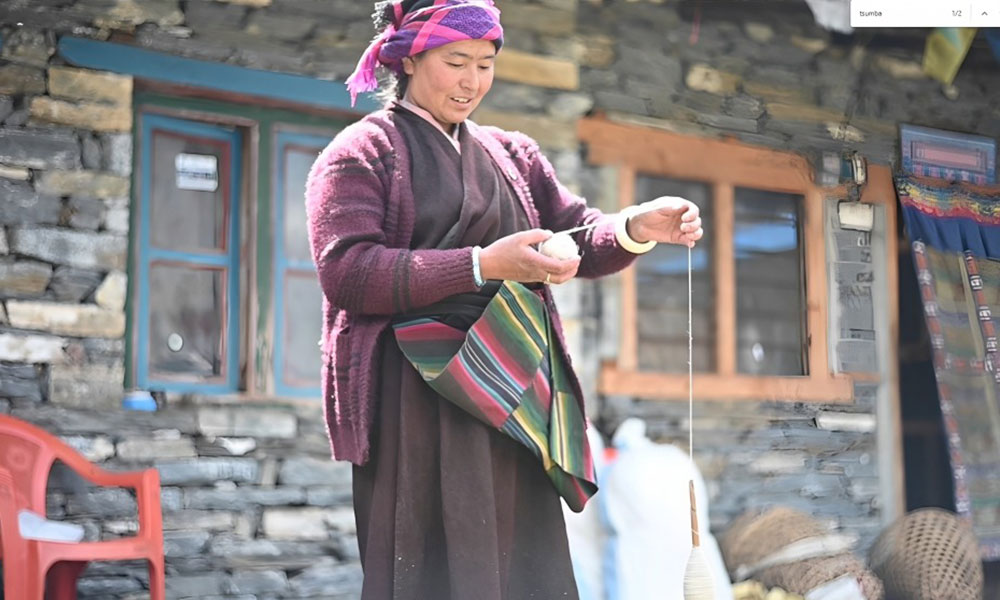
Homes are simple. Stone walls, small windows, and flat roofs that make sense for the weather. Nothing feels built for show — it’s all practical.
You will also notice Mani walls in many places. Long lines of stones with prayers carved into them. People walk past them, sometimes touching them lightly or spinning prayer wheels nearby. It’s part of the routine, not something special set aside.
Most days revolve around work. Farming, looking after animals, preparing food — it follows the seasons more than anything else. Potatoes, barley, and buckwheat — those are common. Yaks and sheep are important too, not just for income but for daily use.
The everyday life in Tsum Valley isn’t quick, but it isn’t idle either. There’s always something to do, just without any rush.

Tsumba People of Manaslu Face Isolation and Change
For a long time, Tsum Valley stayed cut off from the rest of the country. Along with physical isolation, the community has also placed limits on outside influence — outsiders are generally not allowed to buy land or establish businesses within the valley.
That distance helped preserve the Tsum Valley Nepal culture, but it also meant fewer options — schools, health services, and even basic things took effort to access. Life adjusted around that.
Things have started to shift, slowly. Since the valley opened to trekkers, there’s been more movement in and out. Some families earn a bit from visitors. Supplies come in more regularly than before. It’s not a dramatic change, but it’s noticeable.
At the same time, younger people are seeing a different kind of life. Some leave for study or work. Some come back, some don’t. So there’s this in-between stage now. The old ways are still there, but they are not as fixed as before.
Change is occurring even though no one is really forcing it.
Why Tsumba People of Manaslu Matter
Many people come to this region for the trek. But once you spend a bit of time in Tsum Valley, the focus shifts. It’s not just about walking through a place — it’s about understanding how people have lived here for generations.
Knowing a bit about the Tsumba people of Manaslu region changes how you see the journey. The villages, the monasteries, and even the small daily routines start to feel more connected. It adds context that you wouldn’t get otherwise.
Final Thoughts
The Tsumba people of Manaslu haven’t preserved their way of life for anyone watching from outside. They have just continued it, in their own way, over time. That is part of why Tsum Valley feels different. It doesn’t try to stand out or explain itself. It just exists as it is — changing slowly but still holding on to what matters.
FAQs
Where is Tsum Valley?
It’s in northern Gorkha of Nepal, not too far from the Tibetan border. If you are doing the Manaslu trek, it’s a side valley you can turn into, but many people just pass by without going in.
Who are the Tsumba people of Manaslu region?
They are the people who belong to Tsum Valley. Tibetan Buddhism closely ties their culture, and their long isolation has preserved many of their traditions, which continue to shape everyday life.
Why do people say Tsum is a non-violent valley?
People here follow a belief system that encourages them to avoid killing animals or taking part in any kind of violent activity. The community does not enforce these beliefs in a strict way. However, people have practiced it over the years as a shared understanding.
How do the Tsumba people of Manaslu region make decisions?
It’s not like one person decides everything. People usually come together, talk things through, and slowly arrive at a decision everyone can live with. It can take time, but it usually feels more shared than controlled.
Is it easy to visit Tsum Valley?
It is easy if you follow rules and prepare it right. You need permits and a guide, and that’s partly why the place still feels untouched compared to more popular trekking areas.