

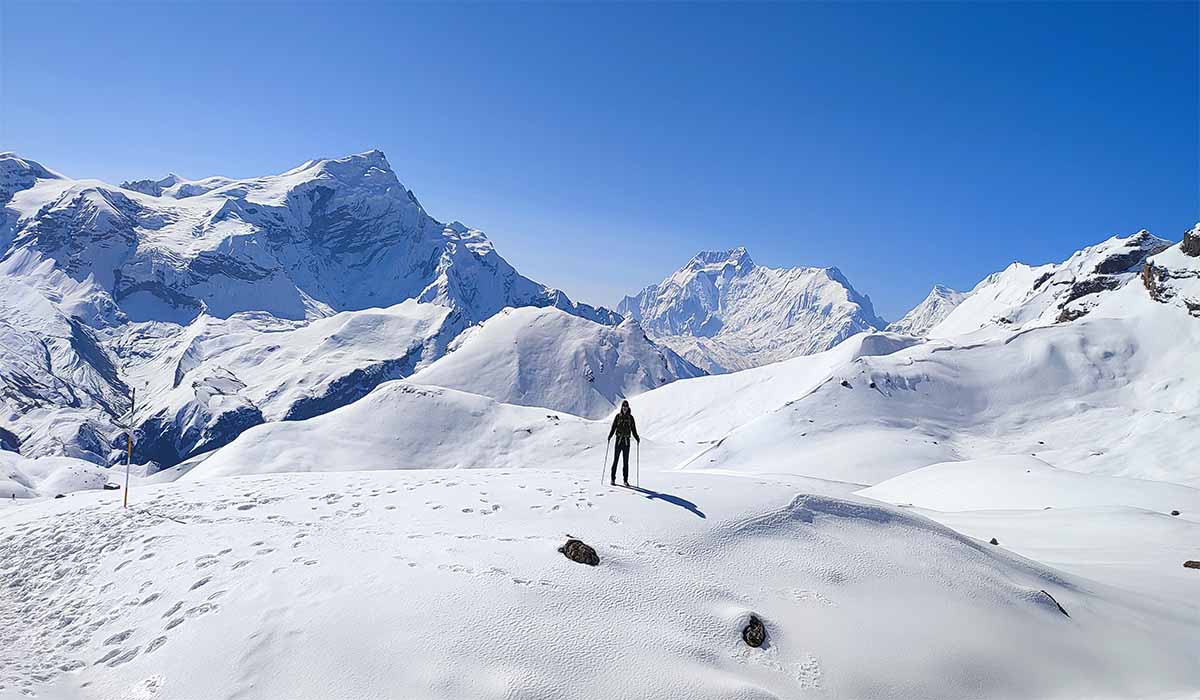

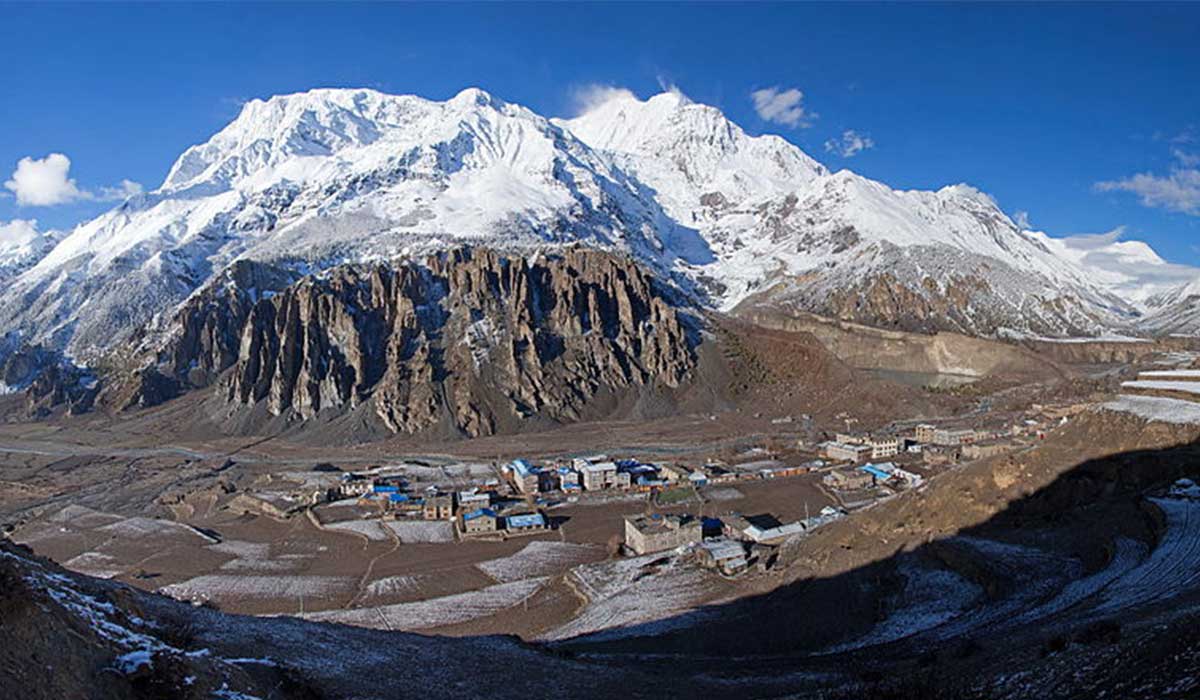
You might want to check out the Annapurna Circuit with Tilicho Lake
Overview
The Annapurna Circuit is one of the most iconic and varied treks Nepal has to offer. It’s got a bit of everything — jaw-dropping mountain scenery, real cultural immersion, and enough adventure to keep things engaging the whole way through.
Depending on your start and finish points, you will cover 160 to 230 kilometers on foot, which usually takes about 12 to 20 days on the trail. Radiant Treks, a founder-led, locally registered trekking agency, offers a 13-day package along with other options.
Trekking the Annapurna Circuit means circling the Annapurna Massif, passing by Annapurna I, Machhapuchhre, Dhaulagiri, and Tilicho Peak. You ascend and descend the trails while viewing beautiful mountains, ultimately crossing the highest point of the journey—Thorong La Pass (5,416 m).
In the process, you travel across six districts of Nepal—Lamjung, Manang, Mustang, Myagdi, Kaski, and Gorkha—all within the Annapurna Conservation Area, the largest protected area in Nepal.
This classic Himalayan adventure takes you through ethnic villages of the Gurung, Thakali, and Manangi communities, giving you a real look at the region’s culture and traditions along the way.
Add to that the route’s other highlights — Muktinath Temple, the villages of Manang and Pisang, the Kali Gandaki Gorge (the deepest gorge in the world), and the option to detour to Tilicho Lake.
You’ll also find well-established teahouses the whole way, which makes the journey a lot more manageable even for solo travelers.
The trek begins with a drive from Kathmandu to Dharapani. From there, you start walking, eventually crossing Thorong La Pass, before returning through Pokhara and back to Kathmandu.
It’s a moderately challenging trip that asks for decent fitness and a bit of preparation — but with the right planning, the Annapurna Circuit delivers one of the best treks in Nepal.
Why Choose This 13-Day Annapurna Circuit Package?
This itinerary is built for people who want the full Annapurna experience without spending half their trip figuring out logistics. Airport pickup, road transfers, hotels, permits, teahouse bookings, meals on the trail — it’s all sorted before you land, so the only thing left for you to do is walk.
We build in a proper rest day in Manang before the push toward Thorong La, because rushing that part of the trek is precisely how people end up turning back. You’ll stay in 3-star hotels in Kathmandu and Pokhara, and we book teahouses ahead of time so you are not left scrambling for a room when the trail gets busy in peak season.
Want something different? Our 16 Days Annapurna Circuit with Tilicho Lake extends the route for those who have a few extra days to spare.
What This 13-Day Trek Actually Costs
The base price runs from $800 per person in groups of five or more up to $1,100 if you are trekking solo. That covers your ground transport, hotels in Kathmandu and Pokhara, all meals on the trail, permits, a licensed guide, and even a loaner sleeping bag and down jacket.
What it doesn’t cover: a porter (an optional $290, usually split between two trekkers), travel insurance, tips, and personal extras like Wi-Fi or hot showers on the trail. Nothing hidden — the price you’re quoted is the price you pay.
How Hard Is the Annapurna Circuit, Really?
Moderate to challenging is the honest answer—not because of technical climbing (there isn’t any) but because of the sheer combination of factors stacked against you.
- You’re walking 5 to 7 hours a day on trails that shift from forest paths to rocky, exposed high-altitude terrain.
- Above Manang, the air thins out fast, and Thorong La Pass tops out at 5,416 m—the actual physical and emotional peak of the trek.
- Nights near Thorong Phedi and High Camp regularly drop below -10°C, even in the main trekking seasons.
- The weather up there can flip from clear to a snowstorm within a single afternoon.
- If snow closes Thorong La, the whole schedule has to flex around it, which is part of why we build in buffer time.
You don’t need mountaineering experience. You do need decent stamina and a willingness to move at the pace your guide sets, not the pace you’d set on your own.
Why Our Itinerary Gives You a Real Shot at Thorong La
We don’t skip the Manang rest day. It’s not filler — it’s the single biggest factor in whether you pass comfortably or struggle through it.
We keep the daily targets sensible. Chame to Pisang, Pisang to Manang, and then the steady climb through Yak Kharka and Thorong Phedi—each stage is sized to let your body catch up before the next one.
Your guide is actually watching, not just walking beside you. Your guide’s job involves conducting oxygen checks, making pace adjustments, and providing a straight answer if the pass needs to wait a day for better weather—it’s more than just pointing you down the trail.
Getting Ready: The Days Before You Hit the Trail
Your first two days in Kathmandu aren’t just for sightseeing—they are for making sure nothing gets missed once you are on the trail. Your guide walks through your gear, checks you are not missing anything critical, and answers whatever questions you have been sitting on. If you are short on a down jacket or a proper sleeping bag, we lend you ours, which you can return after the trek.
It’s also just useful mental prep. A trek like this is as much about knowing what’s coming as it is about fitness—and having that conversation before Dharapani makes the first few trail days feel a lot less uncertain.
Where You’ll Sleep and What You’ll Eat
In Kathmandu and Pokhara: 3-star hotel comfort — real beds, hot showers, Wi-Fi, breakfast included.
On the trail: Teahouses the whole way, twin-sharing. Lower down, in villages like Chame and Pisang, rooms are fairly comfortable. Higher up, past Manang, expect more basic setups — a bed, a blanket, and a shared bathroom that’s sometimes squat-style.
Food-wise: Breakfast, lunch, and dinner are covered throughout, plus fresh fruit after dinner. Dal bhat—rice, lentils, and vegetable curry—is the reliable choice at altitude, and it’s made fresh daily. You’ll find noodles, pasta, and soups on most menus, too, though simpler is usually smarter the higher you climb.
Getting to the Trailhead: Kathmandu to Dharapani
How it works: The trek starts with a 7-8 hour drive from Kathmandu straight to Dharapani, passing through Besisahar and Bhulbhule along the way. Some itineraries route through Pokhara first—ours goes direct, which keeps things simpler and skips an extra overnight before the walking even begins. If you’d rather fly into Pokhara and start from there instead, just let us know when booking.
The road reality: Lower sections of the route now have jeep access, which has changed how some trekkers approach the early days. We factor these changes into the itinerary rather than pretending the trail hasn’t changed.
One thing is worth knowing: Road delays happen, especially in monsoon season—a landslide or washed-out section can add hours. That is why we build buffer time into the schedule instead of risking a tight one.
Who’s Actually Leading You Up There
Your guide is licensed, English-speaking, and knows this route well — not just the trail itself, but how to read the weather near Thorong La and when to call for a rest day instead of pushing through.
Porters are optional, not mandatory—$290, usually split between two trekkers, fully insured, and carrying up to 20-25 kg. Most people who add a porter wish they had done so from day one.
Group size shapes staffing. Smaller groups have one guide throughout; larger groups have a second guide and matching porters, so support remains strong heading into the harder days.
Radiant Treks is a registered, licensed trekking agency—guides are certified, permits are processed properly, and nothing is arranged informally. If you are comparing operators, that’s worth checking for anyone you book with, not just us.
Why Book The Annapurna Circuit Trek With Radiant Treks
- We arrange your airport pickup, long-distance bus rides, and local trail rides, so you never have to navigate Nepal's transport system on your own.
- The route includes a stop in Manang to let your body naturally adjust to the higher elevation before you attempt the climb over Thorong La Pass.
- You'll stay in comfortable hotels (three-star category) in Kathmandu and Pokhara.
- We book your teahouses well ahead of time, so you get better rooms when the trails get crowded.
- All your meals on the trail are fully covered, and we also provide fresh fruit in the evenings.
- The daily plan guides you smoothly through the main highlights from Manang over Thorong La Pass and down to Muktinath.
- We take care of all necessary Annapurna permits and monastery entry fees before the trek even starts.
- You will hike with a licensed, English-speaking guide who knows the trail well and manages the daily pace safely.
- The package covers all your guide's expenses, so you do not have to handle any staff payments on the trail.
- We loan you a down jacket and a sleeping bag, which keeps your duffel bag lighter for your flight to Nepal.
- Your guide carries a first-aid kit and can quickly coordinate an emergency rescue if a medical situation comes up.
- You have the option to pay extra for a one-way flight from Pokhara to Kathmandu if you want to skip the long drive back.
- We give you a real paper map of the Annapurna Circuit so you can trace your route and check your daily progress the traditional way.
- The price you see is the price you pay, so you won't deal with weird surprise costs later.
Detailed Itinerary of 13 days Annapurna Circuit Trek
A representative from Radiant Treks will welcome you at Tribhuvan International Airport in Kathmandu. The same representative will transfer you to your hotel. It is a short drive from the airport to the hotel.
You can relax and settle into the capital city after checking in at the hotel. It is up to you to decide what to do after that. Resting to shake off the jet lag is one option. Strolling around the bustling streets of Kathmandu is another activity you can do .
Thamel is a popular tourist destination featuring numerous shops, cafes, and restaurants. It could be one of your destinations to explore. The evening is free and thus, allows you to get familiar with the Kathmandu atmosphere before starting your actual trek.
Before you trek, on your second day in Kathmandu, you’ll meet with your guide to go through the Annapurna Circuit trek details and make sure you have all the necessary gear. If anything is missing, you can buy it in Thamel or at local shops that sell trekking essentials.
You can visit cultural sites such as Kathmandu Durbar Square or Swayambhunath Temple (Monkey Temple) in the afternoon. The evening streets of Thamel are great for a stroll. And temples offer a chance to immerse yourself in local culture.
You will return to your hotel in the evening to enjoy Dal Bhat, a traditional Nepali meal, as your dinner. After that, you will head to bed early to get a good night’s rest before the trek begins tomorrow.
Elevation Gain: 460 m / 1,509 ft
Drive Distance: 393.4 km / 245 miles
Drive Duration: 8 hours
The third day of the trip entails a thrilling drive from Kathmandu to Dharapani. The journey takes you along the Prithvi Highway, through picturesque villages such as Bhulbhule and Besisahar.
The scenic countryside and views of terraced fields and rushing streams will amaze you along the route. The roads go deeper into the Himalayas and may offer the first glimpses of the Annapurna and Manaslu ranges.
Once you arrive at Dharapani in the Annapurna region, you will find yourself surrounded by towering peaks. Your trek will officially begin from this point.
About Dharapani
Situated at an elevation of 1,860 meters in the Manang district, Dharapani lies to the east along the Annapurna Circuit. Dharapani served as a transit station for merchants traveling between Nepal and Tibet before the Tibetan border closure in 1959. After the closure, the village shifted from its commercial role to focus on tourism.
Today, Dharapani functions as a key checkpoint. It hosts the Annapurna Conservation Area Project and police offices that issue entry permits for the Annapurna and Manaslu trekking regions.
The visitors are attracted by the village’s stone architecture, wooden ornamentation, and colorful Tibetan flags. The vantage point of Dharapani also allows guests to witness views of the Annapurna and Manaslu ranges while enjoying the clear waters of the Marsyangdi River.
Likewise, the village also connects Manaslu trekkers heading towards Bimthang and Larke Pass. Dharapani features plenty of teahouses and guesthouses as well. They offer comfortable stays for those visiting this place.
Elevation Gain: 810 m / 2,657 ft
Trek Distance: 15.7 km / 9.8 miles
Trek Duration: 5 to 6 hours
Today is the day your actual trek begins. You will walk from Dharapani to Chame, the administrative center of Manang. The trails start with a few hours through dense pine forests, passing small villages and rewarding you with spectacular views of Annapurna II, Annapurna I, Annapurna South, Gangapurna, Manaslu, and the surrounding regions.
You will cross suspension bridges over the rushing Marsyangdi River and charming villages such as Bagarchhap, Danakyu, Timang, Thanchok, and Koto where the Gurung people will give you a warm welcome.
The scenery gradually grows more dramatic as you move through green forest with glimpses of the high mountains. Chame is the perfect place to rest and soak in the mountain atmosphere.
About Chame
Chame is the headquarters of Manang and stands at an elevation of 2,670 meters. It is one of the preferred spots to restock supplies before heading to higher elevations. That is possible because it has well-stocked shops, gear stores and healthcare services.
Historically, Chame served as a trading point between Tibet and Nepal. Goods like salt and wool used to be exchanged here. It is now a trek permit checkpoint along the circuit.
The trekkers arriving here can unwind in the natural hot springs of Chame. They can do so while looking at the stunning Annapurna II and Lamjung Himal. The Marsyangdi River adds to the charm of this village, known for its Tibetan Buddhist heritage.
Trekkers have multiple choices for accommodation. The facilities range from riverfront lodges near the Ghatte Khola to quiet stays across the Bailey Bridge. Chame is a perfect blend of landscapes, rich culture and convenient facilities.

Elevation Gain: 630 m / 2,067 ft
Trek Distance : 13.7 km / 8.5 miles
Trek Duration: 5 to 6 hours
Today, you will trek to Pisang. Spectacular landscapes and challenging trails await you as you move forward from Chame. The trail climbs through tree-lined paths before leading you across steep sections toward dramatic rock formations.
As you ascend, you will see sweeping views of Pisang Peak, Dhaulagiri, Gangapurna, and Annapurna II. They look magnificent as they stand against the backdrop of an expanding valley.
One of the most difficult points of the day involves a climb along a rock face, from where you can look down upon the valley below you.
A serene environment welcomes you in Pisang, courtesy of the immense Annapurna mountain range surrounding it.
About Pisang
Pisang is also one of the villages within the Manang district that once served as a stopover for Himalayan traders. In earlier times, merchants traveling between Nepal and Tibet would rest here and exchange goods such as wool and salt.
Over the years, the locals adopted Tibetan Buddhist customs. They have now become a core part of Pisang’s identity. This cultural influence is reflected in the form of monasteries, prayer flags and mani walls in the village.
Perched on a hilltop, Upper Pisang provides summit watchers with breathtaking views of Annapurna and Gangapurna. Meanwhile, Lower Pisang offers comfortable lodging options for trekkers.
Among nearby peaks such as the Annapurna Massif, Manaslu, Gangapurna, and Tilicho, Pisang Peak (6,091 m) stands out. The reason is that it draws the attention of experienced climbers seeking challenging expeditions.
A German mountaineering team succeeded in the first ascent of Pisang Peak in 1955, known for its steep rock slabs. This makes the summit particularly dangerous in snowy conditions.
Fantastic views of the Annapurna range come as a reward for climbers who take on this demanding peak. Today, Pisang serves as a cultural destination and a trekking hub, blending its historical value with stunning mountain views and the warm hospitality of the locals.
Elevation Gain: 240 m
Trek Distance : 17.2 km / 11 miles
Trek Duration: 7 to 8 hours
The sixth day of the Annapurna Circuit Trek requires you to hike from Pisang to Manang. In this day-long journey, you need to pass through the trails that turn rugged and barren with every step you take. The drier conditions of high altitudes are responsible for such a condition of the mountain landscape.
Along the route, you are treated to the views of Annapurna II, Gangapurna, Annapurna South and Pisang. One of the stops along the way is Braga Monastery. This is the biggest monastery in the Manang district. It exudes spiritual vibes of rich Buddhist culture. Put a pause on your trek and try spending some time here amidst its calming ambiance. This is sure to rejuvenate you from the tiring walk of the day.
Finally, you arrive in Manang, the ultimate destination of the day. The traditional stone houses and tranquil setting here are something you fall in love with.
Along with that, it is an ideal place to rest and acclimatize for every trekker who is planning to go further in the Annapurna Circuit Trek. To be able to cross the mighty Thorong La Pass in the upcoming days, one must acclimatize here and try to prevent the risk of altitude sickness.
About Manang
The Himalayan village of Manang stands at an elevation of 3,518 meters, nestled among barren cliffs and dramatic landscapes. The remarkable traditions of the Manangi people are in balance with the arid geographical features of their habitat.
Visitors on the Annapurna Circuit Trek should stop at Manang to see four prominent Himalayan peaks, namely Annapurna, Dhaulagiri, Manaslu and Machhapuchhre.
As mentioned earlier, it is also an acclimatization stop before you take on the Thorong La Pass.
Tourists visiting Manang can visit both Gangapurna Lake and the traditional Braga Monastery. The religious mix of Tibetan Buddhism with ancient Bon religion manifests through Manang’s historic sacred monuments, prayer flags and enduring traditions.
Ghales and Gurungs are the main inhabitants of the village, with their livelihood dependent on agriculture and seasonal tourism.
Along with experiencing local hospitality, visitors can taste traditional Manangi dishes including thukpa, tsampa, and yak momos.
This remote region preserves its authentic traditional character. At the same time it has been gradually modern developments, too.
Today is an essential rest day for acclimatization. Manang sits at an altitude that is high enough for your body to begin adjusting to thinner air. Despite it being a rest day, you should stay active through short hikes on this day. This eventually helps with acclimatization.
One of the popular short hikes is to the glacial lakes near the magnificent Gangapurna Glacier. This gentle trek will prepare your body for the higher altitudes ahead. At the same time, it will reward you with stunning scenery.
Another option is to visit Buddhist sites and explore the cultural facet of Manang. Thus, hiking to the nearby Milarepa Cave Monastery could be one alternative for you. Along with learning about its history, you will continue to make efforts to acclimatize.
Located in a peaceful environment with towering peaks and glaciers as its backdrop, Manang is an ideal place to relax and recharge.
About Gangapurna Lake
Gangapurna Lake in Nepal’s legendary Annapurna region is shaped by the retreat of Gangapurna Glacier. It is a natural attraction of the area at an altitude of 3,440 meters.
Historically, the region was a part of ancient Himalayan trade routes. Merchants and pilgrims passed through the region and left behind their cultural legacies. Meanwhile, the local Gurung and Manangi communities believe Gangapurna Lake as a sacred place with divine powers. Buddhist monks often perform rituals here, adding value to its spiritual significance.
The lake is not only a scenic highlight on the Annapurna Circuit but also an acclimatization point. As you arrive here following the hike from Manang, you can see stunning views of Annapurna III, Dhaulagiri, Macchapuchhre, Manaslu, Gangapurna and Tilicho Peak from its shores. The Pisang Peak vistas are also visible.
Elevation Gain: 490 m / 1,574 ft
Trek Distance: 10.4 km / 6.5 miles
Trek Duration: 4 to 5 hours
During your trek from Manang, you continue ascending the high mountain zone. Spectacular views of the Annapurna II, Annapurna IV, Manaslu, Machhapuchhre, Dhaulagiri, Annapurna III and Gangapurna ranges can be seen along the route.
The landscape gradually becomes more desolate as you ascend, despite the presence of mountain grass and scraggly bushes. Travelers walking along this route frequently encounter blue sheep, along with grazing yaks and Himalayan tahr on the rocky slopes.
Throughout this region, you can travel on horseback. That is possible, as horses are commonly used for transportation across these elevated terrains. Yak Kharka is a small settlement where yak herders tend to rest. Here, you can witness traditional dwellings converted into stone-built teahouses.
The mountain checkpoint of Thorong Phedi sits at 4,450 meters, where numerous Annapurna Circuit trekkers stop before confronting Thorong La Pass. Travelers who use Thorong Phedi as the base camp stay in a couple of tea houses, where basic lodging facilities are available prior to attempting the summit.
About Yak Kharka
Yak Kharka has been known since ancient times for its Nepali meaning: “grazing land for yaks“, and serves as the Manang district’s high-altitude herd grazing area.
Busy trekkers heading to Thorong La Pass have long favored Yak Kharka as their transitional stop since the Annapurna Circuit became internationally renowned.
At 4,020 meters, Yak Kharka offers unparalleled sightlines of Annapurna III along with Gangapurna, Macchapucchre, and Manalsu.
The rural terrain preserves its Indigenous heritage through distinctive architecture and prayer flag traditions of Gurung, Manangi and Tibetan communities. Add to that their warm hospitality.
Mountainside facilities in Yak Kharka include comfortable lodges and popular bakery shops, and access to safe drinking water for travelers.
There is no availability of mobile network coverage after certain stops. In such cases, you can opt for satellite phones for communication purposes.
Yak Kharka stands out as a remarkable stop on the Annapurna Circuit Trek thanks to its natural vistas, cultural richness and trekking facilities.
Elevation Gain: 430 m / 1,411 ft
Trek Distance: 7.3 km / 4.5 miles
Trek Duration: 4 to 5 hours
The route connecting Yak Kharka to Thorong Phedi shows features of rough ground conditions and occasional ground shifts that force hikers to navigate the path carefully. The trek passes through the Kone Khola, where you cross a wooden bridge and later take a steep climb that leads to Ledar village.
The area here is remote, as massive snow-covered mountains form a complete circle around you on all sides. The trail to Thorong Phedi involves short-distance walking while also demanding physical ability due to rising altitudes.
Positioned in a glacial valley, Thorong Phedi functions as a small settlement, while cliffs and high Himalayan ridges constrain the region. This is the last stop before the Thorong La Pass climb. So, you need to spend the night at Thorong Phedi preparing for the next day.
About Thorong Phedi
The mountain checkpoint of Thorong Phedi sits at 4,450 meters, where numerous Annapurna Circuit trekkers stop before confronting Thorong La Pass. Travelers who use Thorong Phedi as the base camp stay in a couple of tea houses, where basic lodging facilities are available prior to attempting the summit.
Located beneath the steep Thorong La hill climb, the area takes its name from Phedi, meaning “foot of the hill”.
Historically, this place served as an essential stopping point before ascending the world’s highest trekking pass, which reaches 5,416 meters.
The area’s main attractions are the mountain vistas, combined with complete acclimatization opportunities and simple living conditions. The high elevation causes reduced oxygen levels, which is the reason proper acclimatization is a must during the trek
Elevation Gain: 1,616 m / 5,282 ft
Trek Distance: 16.4 km / 10 miles
Trek duration: 8 to 9 hours
The Annapurna Circuit Trek reaches its maximum elevation at Thorong La Pass, which allows you to face its formidable yet praised challenges during our tenth day of trekking. You start your hike during the morning hours between 4 and 5 AM to avoid the powerful winds that begin later in the day. Cold temperatures and high altitude make the final 600 meters to the pass extremely difficult.
Wide views of Dhaulagiri, Manaslu, Annapurna II, Annapurna South and Upper Mustang await trek participants upon reaching the summit. A sense of accomplishment washes over you as you arrive at one of the highest points of the region. After soaking in the panoramic views, you start a steady descent toward Muktinath.
Muktinath is a sacred destination for the followers of Hinduism and Buddhism. The Muktinath Temple features an eternal flame. There are 108 water spouts on the temple premises where devotees take a bath with a belief of cleansing souls of sins.
Following this eventful day, you spend the night in Muktinath.
About Muktinath
Muktinath, situated at an elevation of 3,800 meters, is a religious site regarded as sacred by both Buddhists and Hindus. It is renowned for the Muktinath Temple, where Lord Vishnu is worshipped through a Shaligram Shila. It is a fossil stone of divine significance. Likewise, pilgrims are drawn to this place for its 108 sacred water spouts, believed to purify people of their sins.
Local residents regard the Muktinath Temple as a key stop on Nepal’s Char Dham pilgrimage, helping Hindu devotees on their path to spiritual salvation.
The site is also known as Chumig Gyatsa in Tibetan and is revered by Buddhists as a place where Guru Padmasambhava mediated. A structure in the style of a pagoda that dates back to the 19th century stands here. But the religious activities at this location have been in place for centuries.
Access to Muktinath has improved with flights to Jomsom, which connect with both trekking and road routes. The temple’s spiritual and natural appeal is enhanced by its surrounding landscape. It includes panoramic views of Annapurna, Machhapuchhre, Manaslu and Dhaulagiri, attracting both worshipers and trekkers from around the world.
About Thorong La Pass
The Thorong La Pass is one of the trekking attractions in the world, which connects the Manang and Mustang districts in the Annapurna region. The Pass is at an altitude of 5,416 meters and is one of the highest passes on Earth.
Along the route, trekkers can enjoy fantastic views of the Annapurna, Gangapurna, Machhapucchre and Dhaulagiri mountains. They also get to see Annapurna I, II and III, Mt. Manaslu, Fishtail and Tilicho Peak.
The trekkers also explore different settlements along the route, which include Chame, Pisang and Manang. They can meet locals from Gurung and Sherpa backgrounds in these villages.
These paths will also lead you to dense forests and spectacular landscapes. For experienced trekkers, the challenging terrain and changing weather conditions offer an ideal adventure.
This Pass draws the largest number of visitors during the spring and autumn seasons.
Elevation Loss: 2,978 m / 9,791 ft
Drive Distance: 174 km / 109 miles
Drive Duration: 7 to 8 hours
The descent from Muktinath means walking through the settlements of Jharkot and Khingar. Here, Tibetan architecture dominates the buildings. The scenery shifts from dry terrain into richer valley landscapes as you make your way to Marpha. It is an area known for its apple farms and local liquor distillation.
Along the route, Tatopani welcomes you with its natural hot springs. Before arriving here, you need to pass through Kokhethanti and Ghasa. Soaking in Tatopani’s warm waters is a deeply relaxing experience after trekking for days. Likewise, the lower elevation creates a welcoming environment with its more comfortable temperatures.After all the relaxation and enjoyment, you approach the final stretch of your trek with a trip to Pokhara. You drive back while viewing the Annapurna Massif, Dhaulagiri, Manaslu, Machhapuchhre, Gangapurna, Gandharvachuli and Hiunchuli.
About Muktinath Temple
Muktinath Temple is one of the important sites in Mustang district and draws followers of both Hinduism and Buddhism. People visit Muktinath with a belief in attaining salvation. Pilgrims bathe in 108 sacred water spouts to purify themselves from sins.
The temple holds special importance in Hinduism as it is one of the eight self-manifested shrines. Among the Vajrayana Buddhist practitioners, Muktinath is equally significant. It is believed that Guru Rinpoche or Padmasambhava used it as one of his 24 sacred Tantric sites. Muktinath offers spiritual enlightenment and spiritual development for visitors.
Drive Duration: 6 to 7 hours
Flight Duration: 25 minutes
On your drive from Pokhara and Kathmandu, you can continue to observe the scenery of green hills and rivers that have accompanied you throughout your entire trek. During your drive along the Prithvi Highway, you will observe the landscape shift from mountainous countryside to a bustling capital city. You also pass through historic villages like Damauli and Malekhu.
For those feeling exhausted from the trek, we also offer flight services from Pokhara to Kathmandu. This options offers a perspective that is completely different from what you experienced during the trek.
Upon reaching Kathmandu, you will have time to explore the city and shop for souvenirs in Thamel or unwind from the tiring trip. The trek ends here, giving you one last chance to purchase local handicrafts, which include Tibetan jewelry, pashminas and thangka paintings.
Today, you pack up everything you have bought, the souvenirs and the memories you have gathered. For your final moments of leisure, you can visit Swayambhunath Stupa for a last chance to observe the Kathmandu Valley as you say goodbye to Nepal.
As you end your trip, you can wander through Durbar Square to pick up a souvenir. Then enjoy a relaxing meal at a local cafe before your flight home. We will assist you throughout the departure process while providing transportation to the airport. All we want is that you depart Nepal with serene stories and colorful experiences.
Trek Cost Details
Cost Includes
- Airport pick-up and drop-off to/from your hotel
- All ground transportation: public bus (Kathmandu to Dharapani, Muktinath to Pokhara), tourist bus (Pokhara to Kathmandu), with an optional one-way flight available for an additional $100 per person
- Accommodation in 3-star hotels in Kathmandu (three nights) and Pokhara (one night), including breakfast
- Eight nights’ stay in teahouses and lodges along the trekking route
- Standard meals during the trek (breakfast, lunch, and dinner), with fresh fruit served after dinner daily
- Sleeping bag and down jacket provided for the trek (to be returned after completion)
- Professional, licensed English-speaking trekking guide
- Guide’s salary, meals, accommodation, and insurance
- Monastery entry fees
- Annapurna Circuit Trek map
- Arrangement of emergency helicopter rescue services (cost to be covered by trekker or travel insurance)
- Trekking permits, including Annapurna Conservation Area entry fees
- Emergency medical supplies
- Complimentary company T-shirt as a keepsake
- All applicable government taxes and official fees
Cost Excludes
- Porter services (extra $290, can be shared between two trekkers)
- Lunch and dinner in Kathmandu and Pokhara
- All beverages, including bottled water, tea, coffee, soft drinks, and alcoholic drinks
- Additional charges for hot showers, laundry, device charging, and Wi-Fi
- Personal expenses of any kind
- Personal trekking gear and clothing
- Travel insurance covering trekking activities and emergency evacuation
- Costs resulting from unforeseen events or emergencies
- Tips for guides, porters, and support staff
- Optional sightseeing tours or activities in Kathmandu and Pokhara
Essential Info On Annapurna Circuit Trek
Annapurna Circuit Trek Overview
The Annapurna Circuit is a classic Himalayan trek route circling Nepal's massive Annapurna range. What makes it so special is how fast the scenery changes. You start hiking through lush, green valleys and pine forests. But soon you find yourself in arid highlands, ancient trading villages, and Tibetan-style Buddhist communities. Everything builds up to crossing Thorong La Pass. Every few days feels like an entirely different trip.
The Annapurna Circuit sits in north-central Nepal, inside the Annapurna Conservation Area. It spreads across Kaski, Lamjung, Manang, Mustang, and Myagdi districts. The Circuit is famous; it has every feature of a classic Nepal trek. You get massive Himalayan views, high mountain passes, and cozy teahouses, alongside deep cultural roots. Walking through Gurung, Thakali, and Manangi villages makes this journey feel like way more than just a mountain hike.
In fact, they are different names for the same trek. People use both names interchangeably for the same route around the mountains. Both options circle the Annapurna Massif and take you over Thorong La Pass. Depending on road access, starting or ending points might vary slightly, but the core experience is identical. You will still hike through classic villages like Dharapani, Chame, Pisang, Manang, Muktinath, and the lower Mustang region.
The Annapurna Circuit usually takes anywhere from 12 to 20 days, depending on your route, pace, and transport choices. Our team at Radiant Treks sets up a 13-day itinerary for this route (standard package). Total trail distance runs between 160 and 230 kilometers, mostly because modern road access changes where people choose to start and finish walking. No matter your pace, you want a schedule that avoids rushing, especially before tackling Thorong La Pass.
Most trekkers tackle the Annapurna Circuit counterclockwise, starting from the lower Marsyangdi side and crossing Thorong La Pass from the Manang side. Heading this way gives your body way more time to naturally adjust to the altitude before you reach the highest point of the trek. Plus, it makes the actual climb up toward Thorong La much more gradual, which is a whole lot safer than trying to do it the other way around.
It is a moderate hike in terms of difficulty, but you definitely need good stamina to be able to complete this trek. The combination of long walking days, rugged trails, the high altitude, and pushing over Thorong La Pass makes it physically demanding. You will not need climbing skills or technical gear. Still, you should be comfortable walking for several hours a day and patient enough to take the altitude slowly.
Yes, beginners can do the Annapurna Circuit, but it should not be treated like an easy walk. The trail is not technical, but the altitude, long days, and Thorong La Pass make preparation important. If this is your first major trek, train before coming, follow a sensible itinerary, walk slowly, and listen to your guide.
The highest point on the Annapurna Circuit is Thorong La Pass, sitting at 5,416 meters. For most hikers, crossing it is the emotional and physical peak of the whole trip. You’ll start very early that morning because high-altitude weather shifts fast, which adds to the challenge. Even so, you can absolutely reach the pass. The key is taking time to acclimatize properly in places like Manang and sticking to a steady pace.
Expect to see massive peaks such as Annapurna I and II, Dhaulagiri, Machhapuchhre, Gangapurna, Nilgiri, Hiunchuli, Chulu East and West, Tukuche, and Tilicho. But the scenery itself is just as important as the mountains. You actively hike through changing worlds—moving from thick forests and rivers right into dry cliffs, wide valleys, glaciers, and raw, high-altitude terrain. That constant shift is why the trail never becomes boring.
Key highlights on this route include Thorong La Pass, Manang, Pisang, Muktinath Temple, Kali Gandaki Gorge, and Braga Monastery, with the option to add Tilicho Lake. You also spend time in the lakeside city of Pokhara at the end of the journey. Ultimately, the best part of the trek is watching the culture, weather, landscapes, and mountain views change gradually every single day.
Most days on the Annapurna Circuit involve five to seven hours of walking. The terrain varies constantly—expect rocky paths, forest trails, suspension bridges, steep climbs, and dry high-altitude ground. While the route is well-established with teahouses along the way, things like snow, landslides, weather, or road sections can change the conditions. Good boots and a patient pace make all the difference.
Yes, the Annapurna Circuit is still worth doing. The roads have changed some of the lower trail sections, but the heart of the trek is still there: big Himalayan views, old villages, varied landscapes, and the climb over Thorong La Pass. Many trekkers now use jeeps for road sections or follow quieter alternative trails, so the journey still feels rewarding and adventurous.
The Annapurna Circuit is busiest in spring and autumn, especially in the main overnight villages. You will meet other trekkers, but it doesn’t feel crowded all the time. Many parts of the trail still feel open, quiet, and deeply scenic. A good itinerary, early starts, and some alternative trail choices can make the experience much calmer.
Best Time, Weather & Temperature
The absolute best windows for the Annapurna Circuit are autumn (October to November) and spring (March to May).
Autumn offers the crispest, most stable weather. The air is unbelievably clear, giving you postcard-perfect mountain peaks. It is the most popular time, so expect busier trails and teahouses.
Spring is slightly quieter and incredibly colorful. The weather is warm, and you will walk through massive, blooming rhododendron forests. The tradeoff is that afternoon haze can sometimes hide the big peaks.
The temperature and weather on the Annapurna Circuit are not the same from start to finish. The lower villages can feel mild or even warm, but the air gets much colder as you climb toward Manang, Thorong Phedi, and Thorong La Pass. Mornings and nights are usually the coldest. Therefore, you need warm layers even in the main trekking seasons.
Seasonal Weather and Temperature on the Annapurna Circuit Trek
| Season | Weather and temperature |
| Spring: March to May | Spring is one of the most comfortable times to trek. Lower sections are often around 10°C to 20°C during the day, while higher places stay colder, especially early and late in the day. The forests look fresh, rhododendrons bloom, and the mountain views are usually clear. |
| Summer/Monsoon: June to August | This period is the warmest but wettest time. Lower parts of the trail can be warm. Temperatures are often between 20°C and 30°C. Additionally if it rains consistently, the trails get really muddy, and the clouds completely cover the views, which makes the hiking a lot tougher. The valleys are green and quiet, though mountain views are not always reliable. |
| Autumn: September to November | Autumn is the most popular season for a reason. The weather is usually stable, the skies are clearer, and the mountain views are excellent. Daytime temperatures in many villages sit around 10°C to 20°C, but it gets colder as you climb higher. |
| Winter: December to February | Winter is cold and much quieter. Days can still be manageable in lower villages, but higher sections may drop well below freezing, especially near Thorong La Pass. Snow and ice are possible, so proper warm gear and a flexible itinerary are important. |
It gets coldest near Thorong La Pass, especially before sunrise when most trekkers start the crossing. Even in the main trekking seasons, mornings around the pass can feel freezing. In winter, temperatures can drop much lower—they can sometimes be as low as -20°C near Thorong La.
Absolutely. Once you climb above Manang, nights and early mornings regularly drop well below freezing. Even during the peak spring and autumn trekking months, temperatures at high-altitude stops like Thorong Phedi or High Camp can easily plunge to -10°C or lower after sunset. The daytime sun feels warm while you are moving, but the moment it dips behind the mountains, the freeze sets in instantly. Up at Thorong La Pass at 5,416 meters, you can expect sub-zero temperatures and biting winds at any time of year, making heavy winter clothing layers a must.
You should expect a mix of all three, depending on the altitude and the month. The monsoon season brings heavy rain and mud to the lower trails, while winter brings ice and snow higher up. Wind is also a constant once you get into the exposed high-altitude areas.
Yes, but it's a much tougher hike. The cold is brutal, but you will get empty trails and incredible snowy views. Expect freezing temperatures, icy paths, and teahouses that may remain closed in some places. The biggest hurdle is Thorong La Pass—heavy snow frequently blocks it. If you want to tackle the circuit in winter, you need solid high-altitude experience, the right gear, and a very flexible schedule.
Not really. The heavy rains from June to August bring slick, muddy trails and a real risk of landslides lower down, while thick clouds hide the peaks. However, if you don’t mind the downpours, the valleys turn incredibly lush, waterfalls are roaring, and you will have the quiet trails mostly to yourself.
It is incredibly fast, especially as you climb past Manang toward Thorong La Pass. A perfectly blue, calm morning can easily turn into a freezing, windy snowstorm by the afternoon. It’s precisely why we push for early morning starts and rely on guides to read the sky and pivot the plan instantly.
They are both in the same mountain range and are both called "Annapurna treks." But the two are genuinely different journeys. The circuit loops all the way around the Annapurna Massif, crossing Thorong La Pass at 5,416 m and taking you through entirely different landscapes as you go, from lush valleys to dry, high-altitude desert near Mustang.
Annapurna Base Camp Trek, on the other hand, doesn't loop around anything — it heads straight into the Annapurna Sanctuary, a natural amphitheater surrounded by peaks, topping out at a lower 4,130m. ABC is shorter, usually taking 7-12 days, and it doesn't involve a high-pass crossing. If you want the full range of scenery and a proper high-altitude challenge, go Circuit. For a shorter trip that still takes you deep into the mountains, ABC is the better fit.
Stick to spring and autumn. You need the stable weather and clear skies of these peak months to actually see the views from places like Tilicho or Ice Lake. These are grueling, high-altitude climbs, so we only add them to your itinerary once your body has properly acclimatized to the elevation.
Booking, Cost & Trip Policies
Radiant Treks operates the Annapurna Circuit Trek in Nepal. We handle your airport pickup, road transfers, hotels, permits, teahouse stays, trek meals, guide support, and basic emergency backup. You will not have to spend the trip sorting out buses, permits, rooms, or the next day’s trail plan by yourself.
Yes, private and custom dates are possible if the listed departures do not match your travel plans. We can adjust the trek based on how many days you have, how fast you prefer to walk, and any side trips you want to include. Share your travel date with us before you book, and we will look at guide availability, route logistics, and the latest trail situation.
We don't rush the ascent. You will rest for a day in Manang before pushing on to Yak Kharka, Thorong Phedi, and Thorong La Pass. Your body simply needs that time to adapt to the altitude. That specific pause matters immensely on a route like this. Having a clear daily plan also helps us manage walking distances, rest, meals, and overnight stays smoothly.
Your total price depends entirely on group size. Radiant Treks lists the package at USD 1,000 for solo travelers, USD 900 per person for groups of two to four, and USD 800 per person for groups of five or more. Rates decrease for larger groups. That's just because splitting things like transport and a guide among a bigger group keeps everyone's costs down.
We take care of your airport transfers, ground transportation, and hotel stays in Kathmandu and Pokhara. We fully cover the expenses of your teahouse lodging and meals on the trail. Your price also wraps in necessary permits, monastery fees, government taxes, medical supplies, and a trail map. Finally, you get a licensed English-speaking guide alongside sleeping bag and down jacket rentals.
The package does not include personal trekking gear, travel insurance, porters, optional sightseeing, personal drinks, tips, or emergency costs. You also pay separately for small teahouse extras such as hot showers, Wi-Fi, charging, and laundry. These are not part of the standard trek price.
During the trek, most extra costs come from things you buy or use at teahouses. This may include bottled water, tea, coffee, soft drinks, snacks, hot showers, laundry, Wi-Fi, and phone charging. Prices usually increase as you go higher because everything is harder to transport.
Bring enough Nepali rupees to cover your personal travel expenses, tips, and small extras. ATMs and card payments are not reliable on the trekking trail. That is why you need to withdraw or exchange cash in Kathmandu or Pokhara. The exact amount that you need depends on how much money you spend on drinks, showers, charging, and Wi-Fi, among other things.
Not really. Once you hit the trail, power and internet are spotty, so ATMs and card readers are usually down. Power cuts, weak internet, and limited banking services make cash the safest option. Furthermore, exchange or withdraw enough Nepali rupees in Kathmandu and Pokhara before you head out. Once you leave the city, cash is your only practical option.
Please let us know the dates you have in mind. We will verify if those dates are available or not. If everything works, then you can book your trek. For that, you need to pay a 20 percent deposit. It is non-refundable. We use that deposit to hold your accommodation, arrange transport, process permits, and take care of the first trip arrangements.
You can pay the deposit by credit card through WeTravel or Himalayan Bank. Card payments include a four percent processing fee. The remaining balance can be paid in cash or by card after you arrive in Kathmandu, before the trek starts.
The 20 percent booking deposit is non-refundable. If you have paid the full amount and need to cancel, you must inform Radiant Treks in writing. A cancellation made seven days before departure carries a 30 percent charge.
In emergency cases, you may be able to postpone the trek. If you need to switch your dates, you will just have to cover whatever non-refundable costs we have already paid, plus any price difference for the new timing.
Overall, it depends on what you value more: price and flexibility, or having everything bundled from home. When you book with a local Kathmandu-based operator like us, you typically pay less for the same trail, the same teahouses, and the same permits, as there's no overseas office taking a cut along the way. You also get a lot more room to move—need to shift your dates, swap a village, or slow the pace down? We can actually do that, which isn't always true with a fixed international itinerary. What you give up is the ‘everything sorted before you even land’ convenience that some big international names offer. If value and flexibility matter more to you than that, a local operator is usually the better call.
Before you book with anyone, including us, here are the key things to check. Is the agency registered with TAAN, the Nepal Tourism Board, and the Nepal Mountaineering Association? Is your guide actually licensed, and will they share their experience? Does the quoted price clearly cover permits, accommodation, meals, and insurance, not just some of them? And do they have a real answer for what happens if something goes wrong, and how many trekkers are assigned to each guide? If an agency gets vague on any of that, it's worth asking why.
Yes, we are. We're a properly registered trekking agency based right here in Kathmandu, running everything within Nepal's actual tourism regulations, not some informal setup held together with genuine intentions. Our guides are certified, our permits are processed through the proper channels every time, and the whole operation runs the way a licensed company is supposed to, not just something we say on a website.
Nepal Visa, Permits & Entry Requirements
Yes, unless you hold an Indian passport, you will definitely need a visa to enter Nepal. Most travelers can get a visa on arrival at Tribhuvan International Airport in Kathmandu. But double-check the rules for your specific nationality before booking your flight. Just make sure your passport has at least six months left on it. Likewise, keep passport photos handy, and expect a bit of a wait at immigration if you are landing during peak trekking season.
For the Annapurna Circuit Trek, you need the Annapurna Conservation Area Permit, usually called ACAP. You do not need a TIMS card under the current trekking rules. If you book with Radiant Treks, our team arranges the required trekking permits for you, so you do not have to spend your time visiting permit offices in Kathmandu.
You must secure an ACAP permit before starting your trek, since the trail runs directly through the conservation area. You should be prepared to show this paperwork at various checkpoints along the route. Your permit fee goes directly toward critical trail maintenance, environmental protection, and supporting local communities throughout the region.
To arrange your permits sorted, we will just need a copy of your passport, a few passport photos, your trip details, and a copy of your travel insurance policy. If Radiant Treks is managing these permits, we will tell you what to send before the trip. You do not need to worry about arranging the permit yourself when handled through our company.
Transportation & Road Access
The trip kicks off with a drive from Kathmandu up to Dharapani. Your bus winds right through Besisahar and Bhulbhule along the way before you officially start walking. The actual walking begins at Dharapani. If you start from Pokhara, the drive is shorter than from Kathmandu, but travel time depends on the road, traffic, and type of vehicle used.
Some Annapurna Circuit itineraries route you through Pokhara first before heading to the trailhead. Instead, we drive straight from Kathmandu to Dharapani, which keeps things simpler and cuts out an extra overnight stop before the trek even starts. If you'd rather fly into Pokhara and begin from there, that's not a problem; just let us know when you book, and we'll build the itinerary around it.
When traveling the Annapurna Circuit, you can either take a local bus or hire a private jeep. Buses are definitely the budget-friendly option, but the ride is slow and can be a real test of endurance on those rough, unpaved roads. A private jeep costs more, but it’s much faster, a lot more comfortable, and lets you travel on your own schedule.
Road access has changed the lower part of the Annapurna Circuit. Jeeps can now reach several trail towns, and many itineraries begin from places like Dharapani or Chame instead of walking from the old starting points. Depending on the season, the road gets pretty wild—think bumpy, dusty, or completely muddy. If it pours, expect some sections to take way longer than you'd think.
Road delays are a standard part of traveling in Nepal, especially during the monsoon or after heavy rain. If a landslide or roadblock cuts off the route, your guide and driver will immediately figure out the safest alternative.
This usually means waiting for the heavy equipment to clear the debris, walking across the slide to switch into a different vehicle, or just changing your overnight stop entirely. Because these disruptions are so common, you should definitely build a buffer day or two into your schedule.
Radiant Treks’ standard Annapurna Circuit itinerary mainly uses road transport, not domestic flights. The trek ends with a return drive through Pokhara and then back to Kathmandu.
Because road conditions, weather, or trail delays can affect timing, do not book your international flight too soon after the trek. It is safer to keep at least one extra day in Kathmandu.
It is a smart move to leave at least one extra day in Kathmandu before your flight home. Things like road delays, bad weather, sudden landslides, or just slow travel back from Pokhara can easily throw off your schedule. If you can manage it, keeping two buffer days is even safer. This is especially true if you are trekking during the monsoon or winter seasons, or if you have tight flight connections that you absolutely cannot afford to miss.
Arrival In Nepal & City Services
Yes. You need not worry about the logistics. This package covers all your airport pickups and drop-offs. As such, a Radiant Treks team member will take you straight to your hotel after you land at the airport in Kathmandu. You won't have to haggle with local taxis or figure out directions after a long flight. We will also drive you back to the airport when it's time to head home. When your trip ends, we also get you back to the terminal for your flight home.
You will stay in clean, comfortable 3-star hotels in both cities, with breakfast included. We pick these spots because they are centrally located and offer a solid place to rest before hitting the trail or recover after a long trek. If you ever see a custom package that omits the Kathmandu hotel, it is only because that specific trekker wanted to book their lodging or upgrade their stay.
You can pick up a Nepali SIM card—NTC or Ncell—right at the airport arrival terminal or at a shop in Thamel. Setting it up in the city is straightforward, and store staff will help you register it with your passport. While cellular service fluctuates along the Annapurna Circuit, having mobile data is invaluable for staying connected before you head deep into the mountains.
Thamel is the easiest place to exchange money and buy last-minute trekking items in Kathmandu. You will find money changers, gear shops, pharmacies, and stores for snacks or toiletries. Sort these things out before the trek starts, because ATMs, gear shops, and specific supplies become limited on the route.
You definitely shouldn't carry your entire suitcase up the mountain. You can leave your city clothes, extra footwear, and travel bags securely at your Kathmandu hotel or right here at our trekking office for free. Leaving your non-essential baggage behind ensures a much lighter, more comfortable pack on the trail.
Before you head out, Kathmandu (especially the Thamel area) is where you’ll want to be. It’s perfect for picking up last-minute gear, changing cash, trying local food, and grabbing souvenirs.
After the trek, Pokhara is all about relaxing. Most trekkers just head straight to the lakeside to rest up, grab a coffee, and chill out. Nonetheless, both cities feature plenty of good cafés and quick spots to spend your spare time.
Trek Preparation & Training
Start by walking regularly, then build up to longer hikes, uphill routes, stairs, and some light strength training. The Annapurna Circuit is not a technical climb, but you will be walking for several hours a day, often on rough ground. Your legs and lungs matter more than speed here. If you can walk at a steady pace with a small backpack, you are making good progress.
Try to begin training at least six to eight weeks before the trek, especially if you are not very active right now. Start with shorter walks, then slowly add more distance, hills, and a little backpack weight. You do not need an athlete’s routine. Stronger legs and better stamina will simply make the Annapurna Circuit feel much more comfortable and enjoyable.
You need a moderate level of fitness for the Annapurna Circuit. You should be comfortable walking five to seven hours a day on uneven ground, with regular climbs and descents. You do not have to be an athlete, but stronger legs, good stamina, and some hiking practice will make the trek much easier.
Packing & Gear
Pack for changing weather, not just one season. The lower valleys can feel warm, while places near Manang, Thorong Phedi, and Thorong La can be freezing. Bring base layers, warm fleece or down layers, a waterproof jacket, hiking pants, thermal wear, gloves, sunglasses, sunscreen, and good pairs of socks. Pack what you need, but don’t overdo it—your bag should stay light and easy to manage.
Wear waterproof trekking boots with ankle support and a grip for the Annapurna Circuit. The trail can take you over rocky paths, forest tracks, suspension bridges, dusty roads, and steep downhill sections, so your footwear really matters. Do not bring brand-new boots straight to the trek. Wear them in before coming to Nepal, because blisters can make even an easy walking day feel miserable.
Bring a warm sleeping bag rated to about -10°C; you'll want it especially for those cold nights above Manang. For clothing, pack in layers: a base layer, fleece, a down jacket, and a waterproof outer shell. This makes it easier to adjust easily as the temperature changes between warm lower valleys, cold evenings, and high-altitude mornings. Radiant Treks also provides a sleeping bag and down jacket, which you need to return upon completion of the trek.
Trekking poles are a lifesaver for balance and saving your knees on the long descents. You won't always need crampons or microspikes during spring or autumn, but they are great to have in your pack just in case you hit snow or ice near Thorong La Pass. If you are trekking in winter, though, traction gear is a must.
You can easily rent or buy gear right in Kathmandu, especially around Thamel. Pokhara has shops too, but Kathmandu gives you the best selection before heading out. Renting can be useful for bulky items like sleeping bags, down jackets, or trekking poles. However, boots are better brought from home, already tested, and comfortable because they are too important to take the risk.
Your daypack should stay light—keep it around 5 to 7 kg. Carry the things that you need during the trek, like water, snacks, warm layers, rain gear, sunscreen, medicine, documents, and valuables with you. If you hire a porter, pack your main gear in a soft duffel bag, not a suitcase. Packing light makes the trek easier for you.
Accommodation, Food & Trekking Facilities
Accommodation in the Annapurna region during the trek is mostly in local teahouses. They are mountain lodges run by the locals in most of the cases. The rooms are simple, usually with twin beds, blankets, and shared toilet facilities. In the lower villages, places may feel a bit more comfortable, but the facilities become more basic as you go higher.
Private rooms are available in many villages along the Annapurna Circuit, but it depends on the season, group size, and what rooms are free when you arrive. During busy trekking months, twin-sharing rooms are more common. Single rooms are easier to arrange in the lower villages and harder to confirm higher up. Couples and families should request private rooms early so we can do our best to arrange them.
Food on the Annapurna Circuit is simple but enough for trekking days. Most teahouses serve dal bhat, noodles, fried rice, pasta, soup, potatoes, eggs, pancakes, and tea. Radiant Treks provides breakfast, lunch, and dinner for you while you are on the trail. Drinking water is available along the route, but boiled, filtered, or purified water is safer than relying solely on bottled water.
You can get them in most places. Vegetarian food is easy to find on the Annapurna Circuit. Vegan meals are also usually possible, but they need a little care when ordering. You will mostly eat things like dal bhat, veg noodles, soups, potatoes, rice, and Tibetan bread. If you have any allergies or strict dietary needs, just let your guide know before setting off so they can tip off the teahouses ahead of time.
They sure are. You can buy snacks, soft drinks, tea, coffee, chocolate, biscuits, and energy bars in many villages along the trail. Chame, Pisang, and Manang usually have more choices than smaller stops. Prices rise as you go higher because goods are harder to transport. It is smart to carry a few favorite snacks from Kathmandu or Pokhara.
Hot showers are available in some teahouses on the Annapurna Circuit, mostly in the lower and busier villages. They usually cost extra and may not always be hot in the way you expect. At higher altitudes, many trekkers skip showers for a few days because of the cold. Wet wipes can be useful as a backup.
You can wash clothes in some lower villages, but you cannot rely on it every day. Clothes often dry slowly, especially when the weather is cold or cloudy. On shorter walking days, washing socks or a base layer is usually fine. Bigger laundry is best left for Kathmandu or Pokhara, before or after the trek.
Toilets are basic on the Annapurna Circuit, and every teahouse is a little different. Some have Western-style toilets; others still use squat toilets. Shared bathrooms are common, especially higher on the trail. Bring toilet paper, hand sanitizer, and small waste bags. It is basic, but manageable when you are prepared.
You’ll find charging, Wi-Fi signal, mobile signal, and phone service in some villages, but don’t rely on them everywhere. Many teahouses charge extra for Wi-Fi and charging. Signal often gets weak or cuts out in remote areas and higher up. Carry a power bank, and save anything important before leaving Kathmandu or Pokhara.
Yes. It is really a fantastic idea to bring your own power bank for the Annapurna Circuit. You can charge electronic devices at some teahouses, but they usually charge an extra fee, and the electricity isn't always reliable. A solar charger helps on sunny days, but don't rely on it as your only backup. Save your battery whenever you can, especially once you get above Manang.
Most teahouses provide a bed, pillow, and blanket, but rooms are not always heated. Dining rooms may have a stove in the evening, which becomes the warmest place to sit in the lodge. A proper sleeping bag is still important, especially in colder villages above Manang.
Guides & Porters
Yes. Hiring a guide is not mandatory for this trek. It means you are free to trek on your own. But if you would rather not hire a guide, you must feel comfortable following the route, handling the altitude, and making decisions on the trail. We know some people still prefer going with a guide just to have that extra support, but you don't actually have to hire one.
You can definitely hike the Annapurna Circuit by yourself—it's totally legal to do it solo. The trail has teahouses, villages, and checkpoints, so many independent trekkers use this route. Still, go prepared. Carry your ACAP permit, enough cash, and proper insurance, and take altitude seriously, especially as you get closer to Thorong La Pass.
A licensed guide from Radiant Treks will be with you throughout the trek. They take care of the day-to-day details, from setting a comfortable walking pace to sorting out teahouses for you. Their main job, though, is keeping you safe—watching the weather and guiding you through those high-altitude stretches around Manang and Thorong La Pass.
Yes, your guide speaks fluent English. You will easily be able to discuss the route, your meals, or any health and altitude concerns along the way. They also translate for you when chatting with local villagers and teahouse hosts. As such, they help in making the whole journey much smoother.
For smaller groups, one guide is with you the whole way through. Once the group gets bigger, we bring in a second guide and extra porters to match, so nobody is overworked, and there is always someone with experience nearby. That is so true, especially on the harder days heading up toward Thorong La. It's less about a fixed ratio and more about making sure the support actually matches the size of your group.
No, porters aren't included in the standard package of Radiant Treks. But you can easily add one for an extra cost. Most people choose to hire a porter so they only have to carry a light daypack. It makes a massive difference, especially on the long walking days and steep, high-altitude climbs.
Our porters carry up to 20-25 kg, usually splitting it between two trekkers. This limit keeps things manageable and protects the porters on steep trails. Pack only what you really need. Furthermore, remember to use a soft duffel bag because it is easier for porters to carry. Plus, suitcases are not practical on the Annapurna Circuit.
Tipping isn’t mandatory, but it is a big part of the trekking culture here in Nepal if your crew did a fantastic job. Most people hand over a tip on the last day as a thank-you for all the hard work. How much you give is entirely up to you—it usually just depends on how long you were out there, your group size, and how happy you were with the support.
Trek Safety, Altitude & Emergencies
Not in normal conditions, but you are still heading high into the mountains. The main concerns are altitude sickness, freezing weather, snow near Thorong La Pass, seasonal landslides, and the length of the walking days. As long as you acclimatize right, take your time, pack good gear, and listen to an experienced guide, it’s a perfectly safe trek.
It usually starts with a headache, fatigue, dizziness, trouble sleeping, loss of appetite, nausea, or feeling short of breath. Never ignore these signs, especially once you pass Manang and get higher up.
Yes. Once you are past Manang, your guide starts checking your oxygen saturation with a pulse oximeter at key points along the route. It's a small thing, but it catches problems before you'd even feel them—many altitude issues show up in your blood oxygen before they show up as a headache or dizziness. Monitoring your daily condition adds another layer of safety as you approach Thorong La.
Take it slow, drink tons of water, eat well, skip the alcohol, and give your body time to adjust. That rest day in Manang is non-negotiable before you head toward Yak Kharka. Don't rush just because you feel fantastic early on. Up high, walking slowly and steadily is the only way to stay safe.
It is a lot better to skip the alcohol while you are trekking at high altitudes, especially before you cross Thorong La Pass. Drinking dehydrates you quickly, messes with your sleep, and makes it really hard to notice the early warning signs of altitude sickness. You are much better off saving the drinks for after you clear the high pass, when the hardest and highest part of the trek is safely behind you.
Some trekkers use Diamox to help their bodies adjust to the altitude, but you really shouldn't take it without talking to a doctor first. Your trekking guide will be watching for any altitude symptoms and can help make safety calls, but they aren't legally allowed to prescribe or hand out medication. Ultimately, the safest strategy is still just walking slowly, drinking tons of water, acclimatizing properly, and never ignoring a symptom.
Thorong Phedi is usually the safer place to sleep because it is lower than High Camp. Sleeping lower gives your body more time to adjust before crossing Thorong La Pass. High Camp shortens the next morning’s climb, but the altitude can feel harder for some trekkers. The final decision should depend on your health, weather, room availability, and your guide’s advice.
If Thorong La Pass is closed, your guide will not push the crossing. Depending on how bad the weather and trails actually look, the safer call is usually to just wait, head back down to a lower village, or change the route entirely. Heavy snow, high winds, and zero visibility make the pass incredibly risky, so the final choice always comes down to keeping everyone safe.
Your guide will immediately assess you to figure out the safest move—whether that's resting, heading down, finding a local clinic, or calling for help. If it's serious, we can arrange a helicopter evacuation, but that isn't covered in your trek package. That is why having the right travel insurance sorted before you leave is incredibly important.
Yes, you absolutely need it. Make sure your policy covers high-altitude trekking up to 6,000 meters, emergency medical care, helicopter evacuation, trip delays, and lost luggage. Since Thorong La Pass reaches 5,416 meters, a basic vacation policy won’t be enough. Just double-check that specific altitude limit before you buy.
It really depends on your specific condition, fitness, and what your doctor says. Anyone with asthma, heart issues, or blood pressure concerns needs to obtain medical clearance before booking this trek, as it goes incredibly high and involves long, grueling days. Just let us know early on so your guide can fully assist you.
Trek Extensions & Customization
Yes, you can absolutely change up the itinerary. That is a smart move if you want to walk at a slower pace, add some rest days, or stay a bit longer in villages on the trail that you like. It is also a fantastic option if you are nervous about the altitude, hiking with kids, or wanting to take a few side trips. The main thing is to figure these changes out before you book anything. That way, you sort out the route, your permits, the transport, and the final price ahead of time.
You can add Tilicho Lake, Ice Lake, or short hikes around Manang if your schedule has room and your body is handling the altitude well. Tilicho Lake is the best-known side trip, but it adds walking days and should not be forced into a tight plan. It is better to decide on these hikes before the trek begins.
Yes. If you have got extra time in Nepal, you can easily beef up your trek. You could add on Tilicho Lake, Gorepani-Poon Hill-Ghandruk, Annapurna Base Camp, the Nar Phu Valley, or even Upper Mustang. Just remember that every detour changes the difficulty, the permits you'll need, the cost, and the timeline. You'll want to map everything out properly before booking.
Culture & Responsible Travel
This trek is honestly as much about the people as the peaks. As you hike, you will wander right through the heart of Gurung, Manangi, Thakali, and Tibetan communities. It’s a living landscape of colorful prayer flags, rustic stone houses, local farms, and cozy, family-run teahouses. Spending time in spots like Manang, Pisang, and lower Mustang gives the whole journey a wealthy, welcoming feel.
Absolutely, the trail is lined with them. You’ll pass the ancient Bhraga Monastery near Manang and the iconic Muktinath Temple just after crossing Thorong La Pass. Every day you will walk by local shrines, mani walls, and spinning prayer wheels. If your timing is right, you might even catch a local festival—Yartung Horse Festival (August / September), Lhosar (February / March), Mani Rimdu (October / November), and Dashain-Tihar (September - November)—but the spiritual energy is there year-round.
Just treat the trail like you are a guest in someone's home. Dress modestly, always ask before snapping close-up photos of people, and keep to the left so you pass mani walls and prayer wheels clockwise. When teahouses get packed at dinner, a little patience goes a long way. Finally, skip the single-use plastic—stick to reusable bottles and filtered water to help keep these mountain communities pristine.
Definitely, but it isn't a trip that works for everyone. Because of the tough terrain and high altitude, your itinerary needs to match your group's pace. While fit seniors and older kids constantly tackle it, everyone needs to acclimatize properly. Whether you are going solo or bringing family, hiring a local guide can entirely change the game for your safety and peace of mind.
What to Pack for the Annapurna Circuit
Overpacking for this trek will absolutely ruin your knees, but leaving out the essentials means you will be freezing and miserable. The secret is just bringing smart layers. Here is a realistic breakdown of the packing list of items that you need to stay warm, dry, and actually comfortable on the trail of the Annapurna Circuit Trek.
Clothing and Layers
Getting your layers right is everything on this trek since you will be walking through hot valleys one day and freezing mountain passes the next. The secret is packing versatile pieces you can pile on or strip off as the weather changes.
Upper Body
- Quick-dry shirts (3): Stick to merino wool or synthetics. They pull sweat away from your skin and won’t smell awful after two days of hiking.
- Thermal top (1): A heavy-duty base layer. You’ll live in this outfit during the freezing mornings and while sleeping.
- Fleece jacket (1): Your reliable mid-layer. This is important as it keeps you warm while you are moving without making you overheat.
- Down jacket (1): Non-negotiable for the high-altitude nights. It must be thick enough to handle sub-zero weather when the sun goes down.
- Waterproof windbreaker (1): A solid, breathable outer shell. It’s your main shield against sudden rain, snow, and ice-cold wind.
Lower Body
- Pairs of hiking pants (2): Light, quick-drying trousers are best. The zip-off convertible ones look goofy but are incredibly practical when the day warms up.
- Pair of thermal bottoms (1): Essential for the coldest days near the pass and for staying warm under the covers at night.
- Pairs of wool hiking socks (4): Merino wool is worth the money here. They cushion your feet, keep them warm, and prevent painful blisters.
- Underwear (4-5 pairs): Moisture-wicking sports underwear. Avoid cotton at all costs.
Footwear and Headgear
Your feet do all the work, and your head and hands take the brunt of the mountain weather. Investing in broken-in boots and solid cold-weather gear is what keeps you moving comfortably without blisters or frostbite.
Shoes
- Hiking boots (1 pair): Sturdy, waterproof, and absolutely broken-in weeks before your trip. The pass is not the place to find out that your boots give you blisters.
- Camp shoes (1 pair): Light sneakers or sandals. Slipping these on at the teahouse after a long day of hiking feels amazing.
Head and Hands
- Warm beanie (1): A fleece or wool hat that completely covers your ears. You’ll need it the second you hit higher ground.
- Sun hat (1): A baseball cap or bucket hat. The mountain sun is incredibly intense during the day.
- Gloves (1 pair): Insulated, windproof gloves. Your hands will freeze on the early morning trek up Thorong La Pass without them.
Trekking Gear and Electronics
You need gear that can handle freezing temperatures and rough trails without adding unnecessary weight. This section covers the packs that hold your life for the next few weeks and the power backups to keep your electronics running when there are no outlets in sight.
Bags and Packs
- Duffle bag-70L-80L (1): If you’re hiring a porter, this is what they will carry. Get one that is durable as well as water-resistant.
- 1 Daypack-30L (1): The pack you carry yourself. It needs to fit your water, camera, sunscreen, and whatever layers you shed during the day.
- Rain cover (1): A waterproof cover that fits snugly over your daypack. When it rains in the mountains, it pours.
Sleeping and Electronics
- Four-season sleeping bag (1): Get one rated down to -15°C. Teahouses give you blankets, but they aren’t enough when you’re sleeping at 4,000+ meters.
- Headlamp (1): You’ll need this for the 4:00 AM push over the pass. Don’t forget to pack extra batteries since the cold saps them fast.
- Power bank (1): Bring a heavy-duty one. Charging electronics at teahouses gets expensive, and the cold weather drains phone batteries quickly.
Personal Care and First Aid
There are no pharmacies or convenience stores at 4,000 meters, so you have to be totally self-sufficient. This covers the basic hygiene essentials to keep you clean and the medical supplies you need to handle everything from minor blisters to altitude headaches.
Hygiene
- Toiletries: Keep it basic. Travel-sized soap, toothbrush, toothpaste, and a small, quick-dry microfiber towel.
- Toilet paper: Buy 2 or 3 rolls before you leave. Teahouses rarely supply it, and buying it on the trail gets pricier the higher you go.
- Sun protection: High-SPF sunscreen, lip balm, and sunglasses with real UV protection to prevent snow blindness.
Medical Kit
- First aid items: Pack plenty of blister pads, band-aids, ibuprofen for altitude headaches, and rehydration salts.
- Water purification: A water filter bottle, a Steripen, or purification tablets. Buying bottled water hurts the environment and your wallet.
- Altitude medication: Talk to your doctor about Diamox. It’s good to have it in your kit in case the altitude affects you.
Real Stories from our TripAdvisor Page
Curious about what travelers say about Radiant Treks? Discover genuine experiences on our Reviews Page.
Annapurna Circuit Trek 13 Day Route Map


